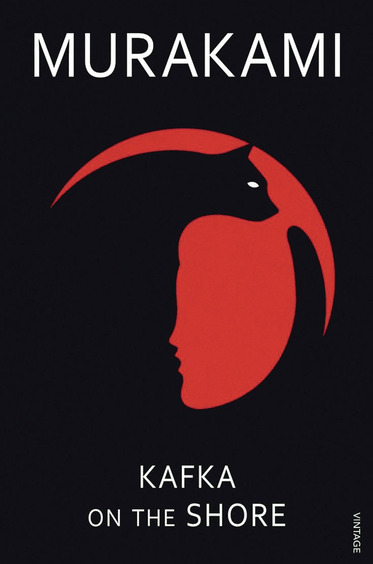




Annotations 
I can do my best to not let any emotions show, keep my eyes from revealing anything, bulk up my muscles, but there’s not much I can do about my looks. I’m stuck with my father’s long, thick eyebrows and the deep lines between them. I could probably kill him if I wanted to—I’m sure strong enough—and I can erase my mother from my memory. But there’s no way to erase the DNA they passed down to me. If I wanted to drive that away I’d have to get rid of me.
There’s an omen contained in that. A mechanism buried inside of me.
The strangest thing was their eyes. Their bodies were so limp it was like they were in a coma, yet their eyes were open as if they were looking at something. They’d blink every once in a while, so it wasn’t like they were asleep. And their eyes moved very slowly from side to side like they were scanning a distant horizon. Their eyes at least were conscious. But they weren’t actually looking at anything, or at least nothing visible. I waved my hand a few times in front of their faces, but got no reaction.
Interview frame
She’s kind of funny looking. Her face is out of balance—broad forehead, button nose, freckled cheeks, and pointy ears. A slammed-together, rough sort of face you can’t ignore. Still, the whole package isn’t so bad. For all I know maybe she’s not so wild about her own looks, but she seems comfortable with who she is, and that’s the important thing. There’s something childish about her that has a calming effect, at least on me. She isn’t very tall, but has good-looking legs and a nice bust for such a slim body.
In traveling, a companion, in life, compassion,’” she repeats, making sure of it. If she had paper and pencil, it wouldn’t surprise me if she wrote it down. “So what does that really mean? In simple terms.”
I think it over. It takes me a while to gather my thoughts, but she waits patiently.
“I think it means,” I say, “that chance encounters are what keep us going. In simple terms.”
By the way, where are we?” I ask.
“I have no idea,” she says. She cranes her neck and sweeps the place with her eyes. Her earrings jiggle back and forth like two precarious pieces of ripe fruit ready to fall. “From the time I’m guessing we’re near Kurashiki, not that it matters. A rest area on a highway is just a place you pass through. To get from here to there.” She holds up her right index finger and her left index finger, about twelve inches apart.
“What does it matter what it’s called?” she continues. “You’ve got your restrooms and your food. Your fluorescent lights and your plastic chairs. Crappy coffee. Strawberry-jam sandwiches. It’s all pointless—assuming you try to find a point to it. We’re coming from somewhere, heading somewhere else. That’s all you need to know, right?”
I nod. And nod. And nod.
“What’s your name?” I ask.
“My name?”
“Yeah.”
“Sakura,” she says. “What about you?”
“Kafka Tamura,” I reply.
“Kafka Tamura,” she muses. “Weird name. Easy to remember, though.”
I nod. Becoming a different person might be hard, but taking on a different name is a cinch.
“I’m staying at my friend’s place for a while, but if you ever feel like seeing somebody, give me a call. We can go out for a bite or whatever. Don’t be a stranger, okay? ‘Even chance meetings’ . . . how does the rest of that go?”
“‘Are the result of karma.’”
“Right, right,” she says. “But what does it mean?”
“That things in life are fated by our previous lives. That even in the smallest events there’s no such thing as coincidence.”
She sits there on her yellow suitcase, notebook in hand, giving it some thought. “Hmm . . . that’s a kind of philosophy, isn’t it. Not such a bad way of thinking about life. Sort of a reincarnation, New Age kind of thing. But, Kafka, remember this, okay? I don’t go around giving my cell phone number to just anybody. You know what I mean?”
When I open them, most of the books have the smell of an earlier time leaking out between the pages—a special odor of the knowledge and emotions that for ages have been calmly resting between the covers. Breathing it in, I glance through a few pages before returning each book to its shelf.
Sensory experience lost with ebooks
I sit down on the swivel chair and quietly rest my hands on the desk.
“How is it? Feel like you could write something?”
I blush a little and shake my head. Miss Saeki laughs and goes back to the couple. From the chair I watch how she carries herself, every motion natural and elegant. I can’t express it well, but there’s definitely something special about it, as if her retreating figure is trying to tell me something she couldn’t express while facing me. But what this is, I haven’t a clue. Face it, I remind myself—there’re tons of things you don’t have a clue about.
Salinger
The hotel is pretty large, a typical second-rate business hotel. I fill in the register at the front desk, giving Kafka instead of my real first name, a phony address and age, and pay for one night.
Yes, everybody tells me that. But this is the only way Nakata can speak. I try to talk normally but this is what happens. Nakata’s not very bright, you see. I wasn’t always this way, but when I was little I was in an accident and I’ve been dumb ever since. Nakata can’t write. Or read a book or a newspaper.”
“Not to boast or anything, but I can’t write either,” the cat said, licking the pads of his right paw. “I’d say my mind is average, though, so I’ve never found it inconvenient.”
They both live in huge houses and eat eel. Nakata’s the only one who isn’t bright.”
“But you’re able to talk with cats.”
“That’s correct,” Nakata said.
“Then you’re not so dumb after all.”
“Yes. No . . . I mean, Nakata doesn’t really know about that, but ever since I was little people said You’re dumb, you’re dumb, so I suppose I must be. I can’t read the names of stations so I can’t buy a ticket and take a train. If I show my handycap pass, though, they let me ride the city bus.”
Nakata can’t really remember. They don’t know why, but I had a high fever for about three weeks. I was unconscious the whole time. I was asleep in a bed in a hospital, they told me, with an intra venus in me. And when I finally woke up, I couldn’t remember a thing. I’d forgotten my father’s face, my mother’s face, how to read, how to add, what my house looked like inside. Even my own name. My head was completely empty, like a bathtub after you pull the plug. They tell me before the accident Nakata always got good grades. But once I collapsed and woke up I was dumb. My mother died a long time ago, but she used to cry about this a lot. Because I got stupid. My father never cried, but he was always angry.”
“Instead of being smart, though, you found yourself able to talk with cats.”
In the Penal Colony,’” Oshima says. “I love that story. Only Kafka could have written that.”
“That’s my favorite of his short stories.”
“No kidding?”
I nod.
“Why’s that?”
It takes me a while to gather my thoughts. “I think what Kafka does is give a purely mechanical explanation of that complex machine in the story, as sort of a substitute for explaining the situation we’re in. What I mean is . . .” I have to give it some more thought. “What I mean is, that’s his own device for explaining the kind of lives we lead. Not by talking about our situation, but by talking about the details of the machine.”
It might sound strange to put it this way, but it seemed like the real Nakata had gone off somewhere, leaving behind for a time the fleshly container, which in his absence kept all his bodily functions going at the minimum level needed to preserve itself. The term “spirit projection” sprang to mind. Are you familiar with it? Japanese folk tales are full of this sort of thing, where the soul temporarily leaves the body and goes off a great distance to take care of some vital task and then returns to reunite with the body. The sort of vengeful spirits that populate
The Tale of Genji may be something similar. The notion of the soul not just leaving the body at death but—assuming the will is strong enough—also being able to separate from the body of the living is probably an idea that took root in Japan in ancient times. Of course there’s no scientific proof of this, and I hesitate to even raise the idea.
Nakata’s own basic problems with talking—not just with cats, but also with people. His easy conversation with Otsuka the previous week was more the exception than the rule, for invariably getting across even a simple message took a great deal of effort. On bad days it was more like two people on the opposite shores of a canal yelling to each other on a windy day. And today was one of those days.
Mr. Kawamura, this is Goma. The cat that Nakata is looking for. A one-year-old tortoiseshell cat. She’s owned by the Koizumis of the 3-chome neighborhood in Nogata, who lost track of her a while back. Mrs. Koizumi opened a window and the cat leaped out and ran away. So once more I’d like to ask you, have you seen this cat?”
Kawamura gazed at the photograph again and nodded.
“If it’s tuna, Kwa’mura tied. Tied up, try to find.”
Neurodivergent with psychic powers trope
This Siamese cat was clever, and educated too. Nakata had met many cats up till this point, but never before one who listened to opera and knew models of cars. Impressed, he watched as Mimi went about her business with a brisk efficiency.
I take the photo of my sister and me at the shore from my wallet and show her. “This is my sister,” I say. Sakura looks at the photo for a while, then hands it back without a word.
Shore
All joking aside,” she says, and smiles broadly to show that she means it, “my point is, in this whole wide world the only person you can depend on is you.”
“I guess so.”
And Crow
Most things are forgotten over time. Even the war itself, the life-and-death struggle people went through, is now like something from the distant past. We’re so caught up in our everyday lives that events of the past, like ancient stars that have burned out, are no longer in orbit around our minds. There are just too many things we have to think about every day, too many new things we have to learn. New styles, new information, new technology, new terminology . . . But still, no matter how much time passes, no matter what takes place in the interim, there are some things we can never assign to oblivion, memories we can never rub away. They remain with us forever, like a touchstone. And for me, what happened in the woods that day is one of these.
But as his teacher I will say there were a couple of things about him that bothered me. Every so often I felt a sense of resignation in him. Even when he did well on difficult assignments, he never seemed happy. He never struggled to succeed, never seemed to experience the pain of trial and error. He never sighed or cracked a smile. It was as if these were things he had to get through, so he just did them. He handled whatever came his way efficiently—like a factory worker, screwdriver in hand, working on a conveyor belt, tightening a screw on each part that comes down the line.
What do you like about it?”
I try putting into words my impressions of the novel, but I need Crow’s help—need him to show up from wherever he is, spread his wings wide, and search out the right words for me.
Dependence
But the world was full of many things Nakata couldn’t hope to fathom, so he gave up thinking about it. With a brain like his, the only result he got from thinking too much was a headache. Nakata sipped the last drop of his tea, screwed the cap on the thermos, and placed it back inside his bag
I pick out a book on the trial of Adolf Eichmann. I have a vague notion of him as a Nazi war criminal, but no special interest in the guy. The book just happens to catch my eye, is all. I start to read and learn how this totally practical lieutenant colonel in the SS, with his metal-frame glasses and thinning hair, was, soon after the war started, assigned by Nazi headquarters to design a “final solution” for the Jews—extermination, that is—and how he investigated the best ways of actually carrying this out. Apparently it barely crossed his mind to question the morality of what he was doing. All he cared about was how best, in the shortest period of time and for the lowest possible cost, to dispose of the Jews. And we’re talking about eleven million Jews he figured needed to be eliminated in Europe.
Sitting in court in Tel Aviv, behind bulletproof glass, Eichmann looked like he couldn’t for the life of him figure out why he was being tried, or why the eyes of the world were upon him. He was just a technician, he insisted, who’d found the most efficient solution to the problem assigned him. Wasn’t he doing just what any good bureaucrat would do? So why was he being singled out and accused?
It’s all a question of imagination. Our responsibility begins with the power to imagine. It’s just like Yeats said: In dreams begin responsibilities. Flip this around and you could say that where there’s no power to imagine, no responsibility can arise. Just like we see with Eichmann.
It doesn’t matter whose dream it started out as, you have the same dream. So you’re responsible for whatever happens in the dream. That dream crept inside you, right down the dark corridor of your soul.”
Just like Adolf Eichmann, caught up—whether he liked it or not—in the twisted dreams of a man named Hitler.
But she got it wrong. What I imagine is perhaps very important. For the entire world.
Lathe of heaven
I work out a bit before dinner. Push-ups, sit-ups, squats, handstands, different kinds of stretching exercises—a routine that keeps you in shape without any machines or equipment. Kind of boring, I’ll admit, but you get a decent workout. A trainer at the gym taught me the routine. “Prisoners in solitary confinement like this best,” he explained, calling it the “world’s loneliest workout routine.” I focus on what I’m doing and go through a couple of sets, my shirt getting sweaty in the process.
That’s right,” Johnnie Walker said. “Truthfully, I’m sick and tired of this life. I’ve lived a long, long time. I don’t even remember how old I am. And I don’t feel like living any longer. I’m sick and tired of killing cats, but as long as I live that’s what I have to do—murder one cat after another and harvest their souls. Following things in the correct order, step one to step ten, then back to one again. An endless repetition. And I’ve had it! Nobody respects what I’m doing, it doesn’t make anybody happy. But the whole thing’s all fixed already. I can’t just suddenly say I quit and stop what I’m doing. And taking my own life isn’t an option. That’s already been decided too. There’re all sorts of rules involved. If I want to die, I have to get somebody else to kill me. That’s where you come in. I want you to fear me, to hate me with a passion—and then terminate me. First you fear me. Then you hate me. And finally you kill me.”
Now that you’ve said hello, I’m afraid we move right into farewells. Hello, good-bye. Like flowers scattered in a storm, man’s life is one long farewell, as they say.”
You have to look!” Johnnie Walker commanded. “That’s another one of our rules. Closing your eyes isn’t going to change anything. Nothing’s going to disappear just because you can’t see what’s going on. In fact, things will be even worse the next time you open your eyes. That’s the kind of world we live in, Mr. Nakata. Keep your eyes wide open. Only a coward closes his eyes. Closing your eyes and plugging up your ears won’t make time stand still.”
What’s the name of the song?”
“‘Kafka on the Shore.’” Oshima says.
“‘Kafka on the Shore’?”
Gays, lesbians, straights, feminists, fascist pigs, communists, Hare Krishnas—none of them bother me. I don’t care what banner they raise. But what I can’t stand are hollow people. When I’m with them I just can’t bear it, and wind up saying things I shouldn’t. With those women—I should’ve just let it slide, or else called Miss Saeki and let her handle it. She would have given them a smile and smoothed things over. But I just can’t do that. I say things I shouldn’t, do things I shouldn’t do. I can’t control myself. That’s one of my weak points. Do you know why that’s a weak point of mine?”
You’re very bright, Mr. Hagita.”
Hagita let out a loud laugh. “It isn’t a question of intelligence. I’m not all that bright, I just have my own way of thinking. That’s why people get disgusted with me. They accuse me of always bringing up things that are better left alone. If you try to use your head to think about things, people don’t want to have anything to do with you.”
Things change every day, Mr. Nakata. With each new dawn it’s not the same world as the day before. And you’re not the same person you were, either. You get what I’m saying?”
“Yes.”
“Connections change too. Who’s the capitalist, who’s the proletarian. Who’s on the right, who’s on the left. The information revolution, stock options, floating assets, occupational restructuring, multinational corporations—what’s good, what’s bad. Boundaries between things are disappearing all the time. Maybe that’s why you can’t speak to cats anymore.”
Someday you will murder your father and be with your mother, he said.”
My father told me there was nothing I could do to escape this fate. That prophecy is like a timing device buried inside my genes, and nothing can ever change it. I will kill my father and be with my mother and sister.”
What you’re talking about, Kafka,” Oshima says, “is just a theory. A bold, surrealistic theory, to be sure, but one that belongs in a science fiction novel.”
“Of course it’s just a theory. I know that. I don’t think anybody else is going to believe such a stupid thing. But my father always used to say that without counterevidence to refute a theory, science would never progress. A theory is a battlefield in your head—that was his pet phrase. And right now I can’t think of any evidence to counter my hypothesis.”
Oshima is silent. And I can’t think of anything else to say.
“Anyway,” Oshima finally says, “that’s why you ran away to Shikoku. To escape your father’s curse.”
Oshima, I don’t want to do those things. I don’t want to kill my father. Or be with my mother and sister.”
“Of course you don’t,” he replies, running his fingers through my short hair. “How could you?”
“Not even in dreams.”
“Or in a metaphor,” Oshima adds. “Or in an allegory, or an analogy.” He pauses and then says, “If you don’t mind, I’ll stay with you here tonight. I can sleep on the chair.”
But I turn him down. I think I’m better off alone for a while, I tell him.
Oshima brushes the strands of hair off his forehead. After hesitating a bit he says, “I know I’m a hopeless, damaged, homosexual woman, and if that’s what’s bothering you . . .”
“No,” I say, “that’s not it at all. I just need some time alone to think. Too many things have happened all at once. That’s all.”
Oshima writes down a phone number on a memo pad. “In the middle of the night, if you feel like talking to anybody, call this number. Don’t hesitate, okay? I’m a light sleeper anyway.” I thank him.
That’s the night I see a ghost.
Though no one else noticed this, he thought his shadow on the ground was paler, lighter, than that of other people. The only ones who really understood him were the cats. On days off he’d sit on a park bench and spend the whole day chatting with them. Strangely enough, with cats he never ran out of things to talk about.
Neurodivergent
You sit at the edge of the world,
I am in a crater that’s no more.
Words without letters
Standing in the shadow of the door.
The moon shines down on a sleeping lizard,
Little fish rain down from the sky.
Outside the window there are soldiers,
steeling themselves to die.
(Refrain)
Kafka sits in a chair by the shore,
Thinking of the pendulum that moves the world, it seems.
When your heart is closed,
The shadow of the unmoving Sphinx,
Becomes a knife that pierces your dreams.
The drowning girl’s fingers
Search for the entrance stone, and more.
Lifting the hem of her azure dress,
She gazes—
at Kafka on the shore.
Do you think Miss Saeki knew what all the lyrics mean?”
Oshima looks up, listening to the thunder as if calculating how far away it is. He turns to me and shakes his head. “Not necessarily. Symbolism and meaning are two separate things. I think she found the right words by bypassing procedures like meaning and logic. She captured words in a dream, like delicately catching hold of a butterfly’s wings as it flutters around. Artists are those who can evade the verbose.”
After a pause she says, “It sounds strange for a boy your age to use a word like damaged, though I must say I’m intrigued. What exactly do you mean by damaged?”
I search for the right words. First I look for the boy named Crow, but he’s nowhere to be found. I’m left to choose them on my own, and that takes time. But Miss Saeki waits there patiently. Lightning flashes outside, and after a time thunder booms far away.
Suddenly, completely out of nowhere, I remember my father talking about how he’d once been struck by lightning. He didn’t tell me himself—I’d read about it in an interview in a magazine. When he was a student in art college, he had a part-time job as a caddy at a golf course. One day he was following his golfer around the course when the sky suddenly changed color and a huge thunderstorm crashed down on them. They took refuge under a tree when it was hit by a bolt of lightning. This huge tree was split right in two. The golfer he was caddying for was killed, but my father, sensing something, leaped away from the tree in time. He got some light burns, his hair was singed, and the shock of the lightning threw him against a rock. He struck his head and lost consciousness, but survived the ordeal with only a small scar on his forehead
The caddy who lived
There are just too many coincidences. Everything seems to be speeding up, rushing toward one destination.
So you really were dead?”
“I was.”
“Where were you all that time?”
“Nakata doesn’t remember. It felt like I was somewhere far away, doing something else. But my head was floating and I can’t remember anything. Then I came back to this world and found out I was dumb. I couldn’t read or write anymore.”
“You must’ve left your ability to read and write over on the other side.”
“Maybe so.”
I think we should go around asking people, you know, if that stone’s somewhere around here.”
“If you say so, then that’s what Nakata wants to do. I’m pretty dumb, so I’m used to asking people questions.”
“My grandpa always said asking a question is embarrassing for a moment, but not asking is embarrassing for a lifetime.”
She shook her head. “Excuse me for asking, but are you here just to find this stone?”
“Yeah, I don’t know if it’s just to see it. Anyway, I’m from Nagoya. The old guy’s from Nakano Ward in Tokyo.”
“Yes, Nakata’s from Nakano Ward,” Nakata chimed in. “I rode in a lot of trucks, and even got treated to eel once. I came this far and haven’t spent a cent of my own money.”
Christ-like figure
I’ve got a cousin who was born blind, but he goes to see movies,” Hoshino said. “What fun could that be?”
“I can see, but I’ve never been to a movie theater.”
“You’re kidding! I’ll have to take you sometime.”
Framing is everything. In Nirvanna the Band the Show, a blind man going to watch a movie is played for laughs but not so much here.
Mr. Hoshino,” the old man said, his voice clear and piercing, with a bit of an accent.
Hoshino stared at the man in blank amazement.
“Right you are! I’m Colonel Sanders.”
“You look just like him,” Hoshino said, impressed.
“I don’t just look like Colonel Sanders. It’s who I am.”
“The fried-chicken guy?”
The old man nodded heavily. “One and the same.”
Okay. . . . But if you’re the real Colonel Sanders, what the heck are you doing working as a pimp in a back alley in Takamatsu? You’re famous, and must be raking in the dough from license fees alone. You should be kicking back at a poolside somewhere in the States, enjoying your retirement. So what’s the story?”
“No, no,” Colonel Sanders said, shaking his head in irritation. “That’s not it at all. My girls do it all—hand job, BJ, whatever you want, including the old in-and-out.”
“Ah hah—so you’re talking a soapland.”
“What land?”
“Quit kidding around, okay? I’ve got somebody with me, and we’ve got an early start in the morning. So I don’t have time for any fooling around tonight.”
“So you don’t want a girl?”
“No girl. No fried chicken. I’m going back to get some sleep.”
I’m not crazy about the container I’m in, that’s for sure. How could I be—this crummy piece of work? It’s pretty inconvenient, I can tell you. Still, inside here, this is what I think: If we reverse the outer shell and the essence—in other words, consider the outer shell the essence and the essence only the shell—our lives might be a whole lot easier to understand.”
I stare at my hands, thinking about all that blood on them, how sticky they felt. I think about my own essence, my own shell. The essence of me, surrounded by the shell that’s me. But these thoughts are driven away by one indelible image: all that blood.
The real is the internal and our perceptions of ourselves.
Picture a bird perched on a thin branch,” she says. “The branch sways in the wind, and each time this happens the bird’s field of vision shifts. You know what I mean?”
I nod.
“When that happens, how do you think the bird adjusts?”
I shake my head. “I don’t know.”
“It bobs its head up and down, making up for the sway of the branch. Take a good look at birds the next time it’s windy. I spend a lot of time looking out that window. Don’t you think that kind of life would be tiring? Always shifting your head every time the branch you’re on sways?”
“I do.”
“Birds are used to it. It comes naturally to them.
Adapting your POV based on your environment.
Am I in love with Miss Saeki when she was fifteen? Or with the real, fifty-something Miss Saeki upstairs? I don’t know anymore. The
In love with an image. Fan culture.
The girl took Hoshino to a nearby love hotel, where she filled up the bathtub, quickly slipped out of her clothes, and then undressed him. She washed him carefully all over, then commenced to lick him, sliding into a totally artistic act of fellatio, doing things to him he’d never seen or heard of in his life. He couldn’t think of anything else but coming, and come he did.
“Man alive, that was fantastic. I’ve never felt like that,” Hoshino said, languidly sinking back in the hot tub.
“That’s just the beginning,” the girl said. “Wait till you see what’s next.”
“Yeah, but man that was good.”
“How good?”
“Like there’s no past or future anymore.”
“The pure present is an ungraspable advance of the past devouring the future. In truth, all sensation is already memory.”
Henri Bergson,” she replied, licking the semen from the tip of his penis. “Mame mo memelay.”
“I’m sorry?”
“Matter and Memory.
Clash of the holy and the profane. The humourous and the serious. The fantstic and the realistic.
See, you’re ready to go again,” the girl remarked, slowly segueing into her next set of motions. “Any special requests? Something you’d like me to do? Mr. Sanders asked me to make sure you got everything you want.”
“I can’t think of anything special, but could you quote some more of that philosophy stuff? I don’t know why, but it might keep me from coming so quick. Otherwise I’ll lose it pretty fast.”
“Let’s see. . . . This is pretty old, but how about some Hegel?”
“Whatever.”
“I recommend Hegel. He’s sort of out of date, but definitely an oldie but goodie.”
“Sounds good to me.”
“At the same time that ‘I’ am the content of a relation, ‘I’ am also that which does the relating.”
“Hmm . . .”
“Hegel believed that a person is not merely conscious of self and object as separate entities, but through the projection of the self via the mediation of the object is volitionally able to gain a deeper understanding of the self. All of which constitutes self-consciousness.”
“I don’t know what the heck you’re talking about.”
“Well, think of what I’m doing to you right now. For me I’m the self, and you’re the object. For you, of course, it’s the exact opposite—you’re the self to you and I’m the object. And by exchanging self and object, we can project ourselves onto the other and gain self-consciousness. Volitionally.”
“I still don’t get it, but it sure feels good.”
“That’s the whole idea,” the girl said.
Somewhere I don’t know about, something weird is happening to time. Reality and dreams are all mixed up, like seawater and river water flowing together. I struggle to find the meaning behind it all, but nothing makes any sense.
I’m appearing here in human form, but I’m neither god nor Buddha. My heart works differently from humans’ hearts because I don’t have any feelings. That’s what it means.”
Since I’m neither god nor Buddha, I don’t need to judge whether people are good or evil. Likewise I don’t have to act according to standards of good and evil.”
“In other words you exist beyond good and evil.”
“You’re too kind. I’m not beyond good and evil, exactly—they just don’t matter to me. I have no idea what’s good or what’s evil. I’m a very pragmatic being. A neutral object, as it were, and all I care about is consummating the function I’ve been given to perform.”
“Consummate your function? What’s that?”
“Didn’t you go to school?”
“Yeah, I went to high school, but it was a trade school. I spent all my time screwing around on motorcycles.”
I’m kind of an overseer, supervising something to make sure it fulfills its original role. Checking the correlation between different worlds, making sure things are in the right order. So results follow causes and meanings don’t get all mixed up. So the past comes before the present, the future after it. Things can get a little out of order, that’s okay. Nothing’s perfect. If the account book’s basically in balance, though, that’s fine by me. To tell you the truth, I’m not much of a detail person. The technical term for it is ‘Abbreviating Sensory Processing of Continuous Information,’ but I don’t want to get into all that.
Listen—God only exists in people’s minds. Especially in Japan, God’s always been kind of a flexible concept. Look at what happened after the war. Douglas MacArthur ordered the divine emperor to quit being God, and he did, making a speech saying he was just an ordinary person. So after 1946 he wasn’t God anymore. That’s what Japanese gods are like—they can be tweaked and adjusted. Some American chomping on a cheap pipe gives the order and presto change-o—God’s no longer God. A very postmodern kind of thing. If you think God’s there, He is. If you don’t, He isn’t. And if that’s what God’s like, I wouldn’t worry about it.”
What Chekhov was getting at is this: necessity is an independent concept. It has a different structure from logic, morals, or meaning. Its function lies entirely in the role it plays. What doesn’t play a role shouldn’t exist. What necessity requires does need to exist. That’s what you call dramaturgy. Logic, morals, or meaning don’t have anything to do with it. It’s all a question of relationality. Chekhov understood dramaturgy very well.”
“Whoa—you’re way over my head.”
“The stone you’re carrying there is Chekhov’s pistol. It will have to be fired. So in that sense it’s important. But there’s nothing sacred or holy about it. So don’t worry yourself about any curse.”
Hoshino frowned. “This stone’s a pistol?”
“Only in the metaphorical sense. Don’t worry—bullets aren’t about to shoot out.” Colonel Sanders took a huge furoshiki cloth from a pocket and handed it to Hoshino. “Wrap it up in this. Better for people not to see it.”
Mr. Hoshino?”
“Yeah?”
“It’s not just that I’m dumb. Nakata’s empty inside. I finally understand that. Nakata’s like a library without a single book. It wasn’t always like that. I used to have books inside me. For a long time I couldn’t remember, but now I can. I used to be normal, just like everybody else. But something happened and I ended up like a container with nothing inside.”
“Yeah, but if you look at it like that we’re all pretty much empty, don’t you think? You eat, take a dump, do your crummy job for your lousy pay, and get laid occasionally, if you’re lucky. What else is there? Still, you know, interesting things do happen in life—like with us now. I’m not sure why. My grandpa used to say that things never work out like you think they will, but that’s what makes life interesting, and that makes sense. If the Chunichi Dragons won every single game, who’d ever watch baseball?”
You liked your grandfather a lot, didn’t you?”
“Yeah, I did. If it hadn’t been for him I don’t know what would’ve happened to me. He made me feel like I should try and make something of myself. He made me feel—I don’t know—connected. That’s why I quit the motorcycle gang and joined the Self-Defense Force. Before I knew it, I wasn’t getting in trouble anymore.”
“But you know, Mr. Hoshino, Nakata doesn’t have anybody. Nothing. I’m not connected at all. I can’t read. And my shadow’s only half of what it should be.”
If I’d been my normal self, I think I would’ve lived a very different kind of life. Like my two younger brothers. I would have gone to college, worked in a company, gotten married and had a family, driven a big car, played golf on my days off. But I wasn’t normal, so that’s why I’m the Nakata I am today. It’s too late to do it over. I understand that. But still, even for a short time, I’d like to be a normal Nakata. Up until now there was never anything in particular I wanted to do. I always did what people told me as best I could. Maybe that just became a habit. But now I want to go back to being normal. I want to be a Nakata with his own ideas, his own meaning.”
Authentic self.
I don’t really get it, but I guess you’re saying you need this stone to do whatever it is you need to do.”
“That’s right. I have to get the other half of my shadow back.”
Jungian?
I’m scared. As I told you, I’m completely empty. Do you know what it means to be completely empty?”
Hoshino shook his head. “I guess not.”
“Being empty is like a vacant house. An unlocked, vacant house. Anybody can come in, anytime they want. That’s what scares me the most. I can make things rain from the sky, but most of the time I don’t have any idea what I’m going to make rain next. If it were ten thousand knives, or a huge bomb, or poison gas—I don’t know what I’d do. . . . I could say I’m sorry to everybody, but that wouldn’t be enough.”
Johnnie Walker went inside Nakata. He made me do things I didn’t want to. Johnnie Walker used me, but I didn’t have the strength to fight it. Because I don’t have anything inside me.”
Anyway, once you open the entrance stone, all sorts of things will naturally settle back where they’re meant to be, right? Like water flowing from high places to low places?”
Nakata considered this. “It might not be that easy. Nakata’s job is to find the entrance stone, and open it. What happens after that, I’m afraid I don’t know.”
“Okay, but why’s the stone in Shikoku?”
“The stone is everywhere. Not just in Shikoku. And it doesn’t have to be a stone.”
“I don’t get it. . . . If it’s everywhere, then you could’ve done all this back home in Nakano. That would’ve saved a lot of time and effort.”
Nakata rubbed a palm over his close-cropped hair. “That’s a hard question. I’ve been listening to the stone for a while now but can’t understand it all that well yet. But I do think both of us had to come here. We had to cross a big bridge. It wouldn’t have worked in Nakano Ward.”
“Can I ask you something else?”
“Yes.”
“If you do open the entrance stone here, is something amazing going to happen? Like is what’s-his-name, that genie, going to pop out like in Aladdin? Or a prince that’s been turned into a frog will French-kiss me? Or else we’ll be eaten alive by Martians?”
“Something might happen, but then again maybe nothing. I haven’t opened it yet, so I don’t know. You can’t know until you open it.”
“But it might be dangerous, huh?”
“Yes, exactly.”
“Jeez.” Hoshino pulled a Marlboro out of his pocket and lit it. “My grandpa used to always tell me that my bad point was running off with people I didn’t know without thinking what I was doing. I guess I must have always done that. The child’s the father of the man, like they say. Anyhow, there’s nothing I can do about it now. I’ve come all this way, and gone to all the trouble of locating the stone, so I can’t just head on home without seeing it through. We know it might be dangerous, but what the hell. Why don’t we open it up and see what happens? At least it’ll make a great story for the grandkids.”
“Nakata has a favor to ask you, Mr. Hoshino.”
“What’s that?”
“Could you pick up the stone?”
“No problem.”
“It’s a lot heavier than when you brought it.”
Jesus resurrection, moving the stone barring his tomb. Barring the world of the living from the world of the dead.
The people who build high, strong fences are the ones who survive the best. You deny that reality only at the risk of being driven into the wilderness yourself.”
Nobody’s going to help me. At least no one has up till now. So I have to make it on my own. I have to get stronger—like a stray crow. That’s why I gave myself the name Kafka. That’s what Kafka means in Czech, you know—crow.”
You can’t use that strength as a protective wall around you. There’s always going to be something stronger that can overcome your fortress. At least in principle.”
“Strength itself becomes your morality.”
Miss Saeki smiles. “You catch on quickly.”
“The strength I’m looking for isn’t the kind where you win or lose. I’m not after a wall that’ll repel power coming from outside. What I want is the kind of strength to be able to absorb that outside power, to stand up to it. The strength to quietly endure things—unfairness, misfortune, sadness, mistakes, misunderstandings.”
You told me you’d published a book about people who’d been struck by lightning.”
You tell her she must know who you are. I’m Kafka on the Shore, you say. Your lover—and your son. The boy named Crow. And the two of us can’t be free. We’re caught up in a whirlpool, pulled beyond time. Somewhere, we were struck by lightning. But not the kind of lightning you can see or hear.
That night you make love again. You listen as the blank within her is filled. It’s a faint sound, like fine sand on a shore crumbling in the moonlight. You hold your breath, listening. You’re inside your theory now. Then you’re outside. And inside again, then outside. You inhale, hold it, exhale. Inhale, hold it, exhale. Prince sings on, like some mollusk in your head. The moon rises, the tide comes in. Seawater flows into a river. A branch of the dogwood just outside the window trembles nervously. You hold her close, she buries her face in your chest. You feel her breath against your bare skin. She traces your muscles, one by one. Finally, she gently licks your swollen penis, as if healing it. You come again, in her mouth. She swallows it down, as if every drop is precious. You kiss her vagina, touching every soft, warm spot with your tongue. You become someone else there, something else. You are somewhere else.
“There’s nothing inside me you need to know,” she says. Until Monday morning dawns you hold each other, listening to time passing by.
Next he went to a bank and used the ATM to withdraw five hundred dollars. Checking his balance, he found there was still quite a lot left. These past few years had been so busy that he’d hardly had time to spend any money.
I feel like I’m exactly where I belong. When I’m with Mr. Nakata I can’t be bothered with all this Who am I? stuff. Maybe this is going overboard, but I bet Buddha’s followers and Jesus’ apostles felt the same way. When I’m with the Buddha, I always feel I’m where I belong—something like that. Forget about culture, truth, all that junk. That kind of inspiration’s what it’s all about.
Nakata as Jesus. Hoshino as disciple.
When the Haydn concerto was over Hoshino asked him to play the Rubinstein-Heifetz-Feuermann version of the Archduke Trio again. While listening to this, he again was lost in thought. Damn it, I don’t care what happens, he finally decided. I’m going to follow Mr. Nakata as long as I live. To hell with the job!
“There are a lot of things that aren’t your fault. Or mine, either. Not the fault of prophecies, or curses, or DNA, or absurdity. Not the fault of Structuralism or the Third Industrial Revolution. We all die and disappear, but that’s because the mechanism of the world itself is built on destruction and loss. Our lives are just shadows of that guiding principle. Say the wind blows. It can be a strong, violent wind or a gentle breeze. But eventually every kind of wind dies out and disappears. Wind doesn’t have form. It’s just a movement of air. You should listen carefully, and then you’ll understand the metaphor.”
Pointless thinking is worse than no thinking at all.’”
Colonel Sanders, the guy who told me where the stone is,” Hoshino said, “is helping us lie low. But why’s he doing this? Is there some connection between him and Johnnie Walker?”
The more Hoshino tried to unravel it, though, the more confused he got. Better not to try to make sense, he decided, of what basically doesn’t make any. “Pointless thinking is worse than no thinking at all,” he concluded out loud, his arms crossed.
“I know how you feel,” he finally says. “But this is something you have to figure out on your own. Nobody can help you. That’s what love’s all about, Kafka. You’re the one having those wonderful feelings, but you have to go it alone as you wander through the dark. Your mind and body have to bear it all. All by yourself.”
The forest around here is incredibly deep, and there’s hardly anything you could forage for food.”
I nod.
“There’s another world that parallels our own, and to a certain degree you’re able to step into that other world and come back safely. As long as you’re careful. But go past a certain point and you’ll lose the path out. It’s a labyrinth. Do you know where the idea of a labyrinth first came from?”
I shake my head.
“It was the ancient Mesopotamians. They pulled out animal intestines—sometimes human intestines, I expect—and used the shape to predict the future. They admired the complex shape of intestines. So the prototype for labyrinths is, in a word, guts. Which means that the principle for the labyrinth is inside you. And that correlates to the labyrinth outside.”
That’s right. A reciprocal metaphor. Things outside you are projections of what’s inside you, and what’s inside you is a projection of what’s outside. So when you step into the labyrinth outside you, at the same time you’re stepping into the labyrinth inside. Most definitely a risky business.”
I’ve slept for half an hour when there’s a loud thump outside the cabin, like a tree branch snapped and tumbled to the ground. The sound jolts me awake. I get up and walk out to the porch to have a look, but everything looks the same. Maybe this is some mysterious sound the forest makes from time to time. Or maybe it was part of a dream. I can’t tell one from the other.
She’s very different from you. She’s overcome all kinds of obstacles—and not what you’d call normal obstacles, either. She knows all kinds of things you’re clueless about, she’s experienced a range of emotions you’ve never felt. The longer people live, the more they learn to distinguish what’s important from what’s not. She’s had to make a lot of critical decisions, and has seen the results. Again, very different from you. You’re only a child who’s lived in a narrow world and experienced very little. You’ve worked hard to become stronger, and in some areas you actually have. That’s a fact. But now you find yourself in a new world, in a situation you’ve never been in before. It’s all new to you, so no wonder you feel confused.
Not being able to read makes life tough.”
“I imagine so,” Hoshino said. “The commentary with this CD says Beethoven was deaf. He was a famous composer, the top pianist in Europe when he was young. But then one day, maybe because of illness, he started to go deaf. In the end he couldn’t hear a thing. Pretty rough to be a composer who can’t hear. You know what I mean?”
“I think so.”
“A deaf composer’s like a cook who’s lost his sense of taste. A frog that’s lost its webbed feet. A truck driver with his license revoked. That would throw anybody for a loop, don’t you think? But Beethoven didn’t let it get to him. Sure, he must have been a little depressed at first, but he didn’t let misfortune get him down. It was like, Problem? What problem?
Loss of sense. Recurring theme.
These days, though, Nakata’s having a lot of dreams. In my dreams, for some reason, I’m able to read. I’m not as dumb as I am now. I’m so happy and I go to the library and read lots of books. And I’m thinking how wonderful it is to be able to read. I’m reading one book after another, but then the light in the library goes out and it’s dark. Somebody turned off the light. I can’t see a thing. I can’t read any more books. And then I wake up. Even if it’s only in a dream, it’s wonderful to be able to read.”
“Interesting . . . ,” Hoshino said. “And here I’m able to read and hardly ever pick up a book. The world’s a mixed-up place, that’s for sure.”
Choice vs. desire.
I’ll stop the car when you find what you’re looking for. And then the story will develop in a new direction. Do I have that right?”
“Yes, that’s what might happen,” Nakata said.
“Let’s hope so,” Hoshino said, and unfolded the city map in his lap.
My cock’s like some animal with a mind of its own, operating on a different wavelength from the rest of me. When I drink some water my cock automatically absorbs it. I can hear the faint sound of it soaking up the water.
At the same time, in a hollow inside me, something struggles to break out of its shell. Before I realize what’s happening, there’s a pair of eyes turned in on me, and I can observe this whole scene. I don’t yet know if this thing inside me is good or bad, but whichever it is, I can’t hold it back or stop it. It’s still a slimy, faceless being, but it will soon break free of its shell, show its face, and slough off its jelly-like coating. Then I’ll know what it really is. Now, though, it’s just a formless sign. It’s reaching out its hands-that-won’t-be-hands, breaking apart the shell at its softest point. And I can see each and every one of its movements.
The thing inside you has revealed itself. The shell is gone, completely shattered, nowhere to be seen, and it’s there, a dark shadow, resting. Your hands are sticky with something—human blood, by the look of it. You hold them out in front of you, but there’s not enough light to see. It’s far too dark. Both inside, and out.
Hoshino found Oshima an appealing young man. Intelligent, well groomed, obviously from a good family. And quite kind. He’s got to be gay, right? Not that Hoshino cared. To each his own, was his thinking. Some men talk with stones, and some sleep with other men. Go figure.
“Do you think music has the power to change people? Like you listen to a piece and go through some major change inside?”
Specifically, the Kafka on the Shore song. More broadly, does art have the power to change people and, in doing so, change the world?
Still, as I walk along I get the feeling something, somewhere, is watching me, listening to me, holding its breath, blending into the background, watching my every move. Somewhere far off, something’s listening to all the sounds I make, trying to guess where I’m headed and why. I try not to think about it. The more you think about illusions, the more they’ll swell up and take on form. And no longer be an illusion.
But was it? You killed the person who’s your father, violated your mother, and now your sister. You thought that would put an end to the curse your father laid on you, so you did everything that was prophesied about you. But nothing’s really over. You didn’t overcome anything. That curse is branded on your soul even deeper than before. You should realize that by now. That curse is part of your DNA. You breathe out the curse, the wind carries it to the four corners of the Earth, but the dark confusion inside you remains. Your fear, anger, unease—nothing’s disappeared. They’re all still inside you, still torturing you.
You have to overcome the fear and anger inside you,” the boy named Crow says. “Let a bright light shine in and melt the coldness in your heart. That’s what being tough is all about. Do that and you really will be the toughest fifteen-year-old on the planet. You following me? There’s still time. You can still get your self back. Use your head. Think about what you’ve got to do. You’re no dunce. You should be able to figure it out.”
“Did I really murder my father?” I ask.
In this thick wall of trees, on this path that’s not a path, if I stopped breathing, my consciousness would silently be buried in the darkness, every last drop of my dark violent blood dripping out, my DNA rotting among the weeds. Then my battle would be over. Otherwise, I’ll eternally be murdering my father, violating my mother, violating my sister, lashing out at the world forever. I close my eyes and try to find my center. The darkness that covers it is rough and jagged. There’s a break in the dark clouds, like looking out the window to see the leaves of the dogwood gleaming like a thousand blades in the moonlight.
Psychoanalysis
Actually, I don’t have any memories either. I’m dumb, you see, so could you tell me what memories are like?”
Miss Saeki stared at her hands on the desk, then looked up at Nakata again. “Memories warm you up from the inside. But they also tear you apart.”
Nakata shook his head. “That’s a tough one. Nakata still doesn’t understand. The only thing I understand is the present.”
“I’m the exact opposite,” Miss Saeki said.
Nakata doesn’t know about that. In any case, it wasn’t something I chose. I have to tell you this—I murdered someone in Nakano. I didn’t want to kill anybody, but Johnnie Walker was in charge and I took the place of the fifteen-year-old boy who should’ve been there, and I murdered someone. Nakata had to do it.”
Miss Saeki closed her eyes, then opened them and looked him in the face. “Did all that happen because I opened the entrance stone a long time ago? Does that still have an effect even now, distorting things?”
Nakata shook his head. “Miss Saeki?”
“Yes?” she said.
“Nakata doesn’t know about that. My role is to restore what’s here now to the way it should be. That’s why I left Nakano, went across a huge bridge, and came to Shikoku. And as I’m sure you’re aware, you can’t stay here anymore.”
Miss Saeki smiled. “I know,” she said. “It’s what I’ve been hoping for, Mr. Nakata, for a long time. Something I longed for in the past, what I’m longing for right now. No matter how I tried, though, I couldn’t grasp it. I simply had to sit and wait for that time—now, in other words—to come. It wasn’t always easy, but suffering is something I’ve had to accept.”
“Miss Saeki,” Nakata said, “I only have half a shadow. The same as you.”
The shadow is definitely jungian.
Living longer than I should have has only ruined many people and many things,” she went on. “Just recently I had a sexual relationship with that fifteen-year-old boy you mentioned. In that room I became a fifteen-year-old girl again, and made love to him. I don’t know if that was the right thing to do or not, but I couldn’t help it. But those actions must surely have caused something else to be ruined. That’s my only regret.”
“Nakata doesn’t know about sexual desire. Just like I don’t have memories, I don’t have any desire. So I don’t understand the difference between right or wrong sexual desire. But if something did happen, it happened. Whether it’s right or wrong, I accept everything that happens, and that’s how I became the person I am now.”
Ever since I came back to this town,” she said, “I’ve been writing this. A record of my life. I was born nearby and fell deeply in love with a boy who lived in this house. I couldn’t have loved him more, and he was deeply in love with me. We lived in a perfect circle, where everything inside was complete. Of course that couldn’t go on forever. We grew up, and times changed. Parts of the circle fell apart, the outside world came rushing into our private paradise, and things inside tried to get out. All quite natural, I suppose, yet at the time I couldn’t accept it. And that’s why I opened up the entrance stone—to prevent our perfect, private world from collapsing. I can’t remember now how I managed to do it, but I decided I had to open the stone no matter what—so I wouldn’t lose him, so things from the outside wouldn’t destroy our world. I didn’t understand at the time what it would mean. And of course I received my punishment.”
Yes, it was. The process of writing was important. Even though the finished product is completely meaningless.”
“I can’t read or write, so I can’t write things down. Nakata’s just like a cat.”
“Mr. Nakata?”
“How can I help you?”
“I feel like I’ve known you for ages,” Miss Saeki said. “Weren’t you in that painting? A figure in the sea in the background? White pants legs rolled up, dipping your feet in the water?”
That’s the reality of it. It did happen,” the boy named Crow says. “You were hurt badly, and those scars will be with you forever. I feel sorry for you, I really do. But think of it like this: It’s not too late to recover. You’re
Trauma
You must think it’s strange we still lug around these heavy lumps of steel,” the tall one says, turning around. “They’re worthless. Never had any bullets anyway.”
“But they’re a kind of sign,” the brawny one says, not looking back at me. “A sign of what we left behind.”
“Symbols are important,” the tall one adds. “We happen to have these rifles and soldiers’ uniforms, so we play the part of sentries. That’s our role. Symbols guide us to the roles we play.”
I have a lot to thank you for too, Mr. Nakata.”
“Is that right?”
“It’s been about ten days since all this began,” Hoshino said. “I’ve skipped out on work the whole time. The first couple of days I got in touch with them and asked for some time off, but right now I’m sort of AWOL. I probably won’t get my old job back. Maybe, if I get down on my knees and apologize, they might forgive me. But it’s no big deal. Not to brag or anything, but finding another job won’t be hard—I’m a great driver and a good worker. So I’m not worried about that, and neither should you be. What I’m trying to say is that I don’t have any regrets about being with you. These past ten days there’s been a lot of bizarre stuff going on. Leeches falling from the sky, Colonel Sanders popping up out of thin air, hot sex with this drop-dead-gorgeous philosophy major, swiping the entrance stone from that shrine. . . . A lifetime of weird stuff packed into ten days. Like we’ve been doing test runs on a roller coaster or something.”
You changed my life. These past ten days, I don’t know—things look different to me now. Stuff I never would’ve given a second glance before seems different. Like music, for instance—music I used to think was boring really gets to me now. I feel like I’ve gotta tell somebody about this or bust, somebody who’ll understand what I’ve gone through. Nothing like this ever happened to me before. And it’s all because of you. I’ve started to see the world through your eyes. Not everything, mind you. I like how you look at life, so that’s why it happened. That’s why I’ve stayed with you through thick and thin, why I couldn’t leave you. It’s been one of the most meaningful times I’ve ever had in my life. So there’s no need for you to be thanking me—not that I mind it. I should be thanking you. All I’m trying to say is you’ve done me a lot of good, Mr. Nakata. Do you know what I’m saying?”
But Nakata wasn’t listening anymore. His eyes were shut, his breathing regular as he slept.
“What a happy-go-lucky guy,” Hoshino said, and sighed.
Nakata had passed away calmly in his sleep, most likely not thinking of anything. His face was peaceful, with no signs of suffering, regret, or confusion. Very Nakata-like, Hoshino concluded. But what his life had really meant, Hoshino had no idea. Not that anybody’s life had more clear-cut meaning to it. What’s really important for people, what really has dignity, is how they die. Compared to that, he thought, how you lived doesn’t amount to much. Still, how you live determines how you die. These thoughts ran through his head as he stared at the face of the dead old man.
Standing there halfway down the slope, staring down at this place with two soldiers, I feel those ripples shifting inside me. These signs reconfigure themselves, the metaphors transform, and I’m drifting away, away from myself. I’m a butterfly, flitting along the edges of creation. Beyond the edge of the world there’s a space where emptiness and substance neatly overlap, where past and future form a continuous, endless loop. And hovering about there are signs no one has ever read, chords no one has ever heard.
The Metamorphosis.
How was the food?” she asks after I finish eating.
“It was really good.”
“Even without any meat or fish?”
I point to the empty plate. “Well, I didn’t leave anything, right?”
No meat in the afterlife. We’re on the other side. The spirit world.
Spending a night in the same house as a corpse was a first, and Hoshino couldn’t settle down. Not that he was scared or anything, he told himself. It didn’t make his flesh crawl. He just didn’t know how he should act with a dead man beside him. The flow of time is so different for the dead and the living. Same with sounds.
Forest
The stone was mute.
“Whatever,” Hoshino said. “That’s just my opinion. I’ll shut up so we can listen.”
When he looked outside at two, a fat black cat was sitting on the railing on the veranda, gazing in at the apartment. Bored, Hoshino opened the window and called out, “Hey there, kitty. Nice day, isn’t it?”
“Yes, indeed, it is a fine day, Mr. Hoshino,” the cat replied.
“Gimme a break,” Hoshino said, shaking his head.
Power transfer
He gave the ankle of his hiking boots a good slap. “To leap to the conclusion here, you won’t be able to stop me. You aren’t qualified. Let’s say I play my flute, what’s going to happen? You won’t be able to come any closer to me. That’s the power of my flute. You might not know this, but it’s a unique kind of flute, not just some ordinary, everyday instrument. And actually I’ve got quite a few here in my bag.”
Magic flutes. Control souls? Pan.
The man reached out and carefully patted the bag, then looked up again at the boy named Crow perched on his branch. “I made this flute out of the souls of cats I’ve collected. Cut out the souls of cats while they were still alive and made them into this flute. I felt sorry for the cats, of course, cutting them up like that, but I couldn’t help it. This flute is beyond any world’s standards of good and evil, love or hatred. Making these flutes has been my longtime calling, and I’ve always done a decent job of fulfilling my role and doing my bit. Nothing to be ashamed of. I got married, had children, and made more than enough flutes. So I’m not going to make any more. Just between you and me, I’m thinking of taking all the flutes I’ve made and creating a much larger, far more powerful flute out of them—a super-size flute that becomes a system unto itself. Right now I’m heading to a place where I can construct that kind of flute. I’m not the one who decides whether that flute turns out to be good or evil, and neither are you. It all depends on when and where I am. In that sense I’m a man totally without prejudices, like history or the weather—completely unbiased. And since I am, I can transform into a kind of system.”
The man cleared his throat once more, and rubbed the slight swell of his belly. “Do you know what limbo is? It’s the neutral point between life and death. A kind of sad, gloomy place. Where I am now, in other words—this forest. I died, at my own bidding, but haven’t gone on to the next world. I’m a soul in transition, and a soul in transition is formless. I’ve merely adopted this form for the time being. That’s why you can’t hurt me. You follow me? Even if I were to bleed all over the place, it’s not real blood. Even if I were to suffer horribly, it’s not real suffering. The only one who could wipe me out right now is someone who’s qualified to do so. And—sad to say—you don’t fit the bill. You’re nothing more than an immature, mediocre illusion. No matter how determined you may be, eliminating me’s impossible for the likes of you.” The man looked at the boy named Crow and beamed. “How ’bout it? Want to give it a try?”
Then let’s get going.”
“Better not look behind you,” the brawny one says.
“Yeah,that’s a good idea,” the tall one says.
And once again I set off through the forest.
Once, as we’re hurrying up a slope, I do glance back. The soldiers warned me not to, but I couldn’t help it. This is the last spot you can see the town from. Beyond it we’ll be cut off by a wall of trees, and that world will vanish from my sight forever.
Orpheus
Don’t forget what I told you about bayonets,” the tall soldier says. “When you stab the enemy, you’ve got to twist and slash, to cut his guts open. Otherwise he’ll do it to you. That’s the way the world is outside.”
“That’s not all there is, though,” the brawny one says.
“No, of course not,” the tall one replies, and clears his throat. “I’m just talking about the dark side of things.”
“It’s also real hard to tell right from wrong,” the brawny one says.
“But it’s something you’ve got to do,” the tall one adds.
“Most likely,” the brawny one says.
“One more thing,” the tall one says. “Once you leave here, don’t ever look back until you reach your destination. Not even once, do you understand?”
“This is important,” the brawny one adds.
“Somehow you made it through back there,” the tall one says, “but this time it’s serious. Until you get to where you’re going, don’t ever look back.”
“Ever,” the brawny one says.
“I understand,” I tell them. I thank them again and say good-bye.
The two of them come to attention and salute. I’ll never see them again. I know that. And they know that. And knowing this, we say farewell.
I don’t recall much of how I got back to Oshima’s cabin after leaving the soldiers. As I made my way through the thick forest my mind must have been elsewhere. Amazingly, I didn’t get lost. I have a vague memory of spotting the daypack I’d thrown away and, without thinking, picking it up. Same with the compass, the hatchet, the can of spray paint. I remember seeing the yellow marks I’d sprayed on tree trunks, like scales left behind by some giant moth.
Perseus? labyrinth
It’s 4:16.
1 minute after Seki died. Time stopped in limbo.
We’ll never see each other again, but I’ll never forget you. Even if I tried to, I don’t think I could.”
With a loud rattle the air conditioner shut off.
“You know what, Gramps?” he went on. “I think that whenever something happens in the future I’ll always wonder—What would Mr. Nakata say about this? What would Mr. Nakata do? I’ll always have someone I can turn to. And that’s kind of a big deal, if you think about it. It’s like part of you will always live inside me. Not that I’m the best container you could find, but better than nothing, huh?”
But the person he was addressing was nothing more than a shell of Mr. Nakata. The most important part of him had long since left for another place. And Hoshino understood this.
“Hey there,” he said to the stone, and reached
Thanks, I could use some.” I am pretty thirsty, but hadn’t realized it until he mentioned it.
The dead in limbo are always thirsty.
Every one of us is losing something precious to us,” he says after the phone stops ringing. “Lost opportunities, lost possibilities, feelings we can never get back again. That’s part of what it means to be alive. But inside our heads—at least that’s where I imagine it—there’s a little room where we store those memories. A room like the stacks in this library. And to understand the workings of our own heart we have to keep on making new reference cards. We have to dust things off every once in a while, let in fresh air, change the water in the flower vases. In other words, you’ll live forever in your own private library.”
Life is loss
Time weighs down on you like an old, ambiguous dream. You keep on moving, trying to slip through it. But even if you go to the ends of the earth, you won’t be able to escape it. Still, you have to go there—to the edge of the world. There’s something you can’t do unless you get there.
Did I do the right thing?
“You did the right thing,” the boy named Crow says. “You did what was best. No one else could have done as well as you did. After all, you’re the genuine article: the toughest fifteen-year-old in the world.”
“But I still don’t know anything about life,” I protest.
“Look at the painting,” he says. “And listen to the wind.”
I nod.
“I know you can do it.”
I nod again.
“You’d better get some sleep,” the boy named Crow says. “When you wake up, you’ll be part of a brand-new world.”
You finally fall asleep. And when you wake up, it’s true.
You are part of a brand-new world.
The world renewed every time we sleep and wakeup. During our sleep, perhaps we’ve also changed. Another reference to the Metamorphosis.
None of the art/writing on this site was generated by LLMs.
If you'd like to get in touch with me, check out my about page.
Follow me with an RSS reader to be notified when I write something.