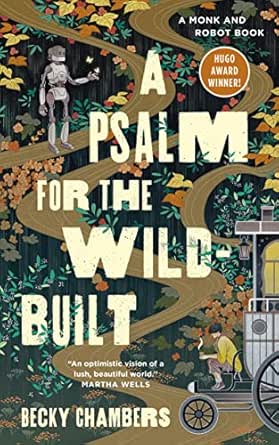




A cozy speculative fiction novella featuring a sad human and, eventually, a happy robot going on an adventure of self and mutual discovery through the philosophical dialogues they have with each other along the way.
Annotations 
For the Cosmites, the answer to that question remains Chal. By their sect’s ethos, hard labor is equal to goodness, and the purpose of a tool is to bolster one’s own physical or mental abilities, not to off-load one’s work entirely.
The Cosmites don’t show up often in A Psalm for the Wild-Built but they’re consistently depicted as being very into the Protestant work ethic and as being wary of tools/machines being used to think and work for us.
This introduction chapter does a good job of setting the scene for the world of Panga (Pangea anyone?) which in its not-so-distant history was forever changed by the liberation of the robots from the human factories.
The robots left the human world, only asking one thing from the humans: to be left alone.
Robots, they’ll remind you, possessed no self-aware tendencies whatsoever when they were first deployed, and were originally intended as a supplement to the human workforce, not as the full replacement they became.
Reading A Psalm for the Wild-Built, and most speculative fiction, in 2026 hits a little different because of the current moment of both hyper-cynicism and mega-fanaticism surrounding the technology of LLMs.
Either way, I’ll be continue honing my ability to critically think whether or not machines achieve sapience.
Unlike was the case in the hopeful world of Panga, we will almost definitely destroy ours before the machines achieve sapience.
Dex climbed the small ladder to the second deck. All memory of their neck knot vanished from existence as they viewed the bed. The sheets were creamy, the pillows plentiful, the blankets heavy as a hug. It looked impossibly easy to fall into and equally difficult to get out of.
The dream of being given a mobile home crafted by an artisan at no cost. Now that’s the definition of cozy (and a completely escapist fantasy).
To Chambers’s credit, she (interestingly Chambers uses she/her pronouns unlike many of the characters in her work) does mention the recycling of gray water.
Shit exists and must be dealt with even in the coziest of worlds.
My partner and I got him when he was a kitten. We’d wanted kids, but that didn’t work out, so we got Flip, and—and he’s really the only thing we had in common anymore. People change so much in twenty years, y’know? If we met now, I don’t think we’d have any interest in each other. It’s been a year since we had sex.
Like Martha Wells’s The Murderbot Diaries (who’s blurb appears on the front cover of A Psalm for the Wild-Built’s English edition), Chambers makes a generally successful attempt at constructing the concerns of Sibling Dex, Mosscap and the rest of the people living in Panga such that the readers can easily relate to them.
The world of Panga is an extremely far out there world compared to our own but the people in it are “just like us”.
Chambers does a more consistently good job at this than Martha Wells does in her The Murderbot Diaries series.
I still have nightmares about her extremely blurry and lacking in detail depiction of dozens-strong gig economy coworker slash romantic partner polycules from that series. Basically, the dystopian world of the text clashes severely with the escapist leaning of the text.
Fifty percent of Panga’s single continent was designated for human use; the rest was left to nature, and the ocean was barely touched at all. It was a crazy split, if you thought about it: half the land for a single species, half for the hundreds of thousands of others. But then, humans had a knack for throwing things out of balance. Finding a limit they’d stick to was victory enough.
A recurring theme in the text is Anthropocentrism being very bad. Human exceptionalism is presented as the cause of most, if not all, of the problems in Panga, mostly ecological and ethical in nature. Much like our own world but Panga is on a better path than ours. A path that won’t lead to the inevitable end of it all.
At the center of the village circle lay Dex’s quarry—the marketplace. They parked both bike and wagon, and began to explore on foot.
Theft doesn’t seem to be much of a problem on Panga. I don’t know anyone who rides a bike that wasn’t probably stolen at some point or another.
The first time Dex had encountered waiting people, it had felt stressful, but Dex had quickly learned to not let it trouble them. […] The thing the people wanted took time to prepare. If they wanted it, they could wait.
At face value, this might seem obvious. But this is a simple lesson that’s been hard for me to internalize in my own life.
Something to keep in mind.
The icons of the Parent Gods were the first to take their place on the small table, set upon a wooden stand cut for this very purpose. A perfect sphere represented Bosh, God of the Cycle, who oversaw all things that lived and died. Grylom, God of the Inanimate, was symbolized by a trilateral pyramid, an abstract nod to their realm of rock, water, and atmosphere. Between them was placed the thin vertical bar of Trikilli, God of the Threads—chemistry, physics, the framework that lay unseen. Below their Parents, directly on the table, Dex arranged the Child Gods: a sun jay for Samafar, a sugar bee for Chal, and of course, the summer bear.
Knowing that Chambers was commissioned to write this novella as well as its sequel makes the reading and critique of the decisions made more fraught then it would be otherwise.
Why are the gods of this world so omnipresent in the text? Are they used to achieve some sort of effect other than perhaps catering to a demographic of New Age tarot-reading crystal-rubbing women?
Novels aren’t written in a vacuum and knowing how a novel was written, who wrote it and why they did (probably to make money) can sometimes give helpful context to help with deconstructing novel.
A reliable device built to last a lifetime, as all computers were.
hehe hehe hehe hehe (dies of disbelief)
The road from the Woodlands led to the road to the Coastlands, which led to the Riverlands, which led to the Shrublands, and back to the Woodlands once more. Dex made their circuit again, and again, and again, and every stop they made, they found gratitude, gifts, goodwill.
Lucky for us, Dex wants to go on an adventure. They want to travel on a untrodden path into the unknown.
Nobody in the world knows where I am right now, they thought, and the notion of that filled them with bubbling excitement. They had canceled their life, bailed out on a whim. The person they knew themself to be should’ve been rattled by that, but someone else was at the helm now, someone rebellious and reckless, someone who had picked a direction and gone for it as if it were of no more import than choosing a sandwich. Dex didn’t know who they were, in that moment. Perhaps that was why they were smiling.
Funnily enough, they already escaped from their previous cloistered life at the monastery to become a traveling tea monk. Now they want to become a traveling … something.
Dex is slowly discovering the joy of the journey rather than the destination.
A goal reached is a goal soon forgotten. If we don’t cherish the steps along the journey, life can become a series of staircases.
Dex would not finish that particular verse, because in that moment, a seven-foot-tall, metal-plated, boxy-headed robot strode briskly out of the woods.
“Hello!” the robot said.
Dex froze—butt out, hair dripping, heart skipping, whatever thoughts they’d been entertaining vanished forever.
The robot walked right up to them. “My name is Mosscap,” it said, sticking out a metal hand. “What do you need, and how might I help?”
Mosscap is great. No notes.
“Sorry,” Dex said to the remains of the bug as they wiped it on a kitchen cloth.
The robot noted this. “Did you just apologize to the bloodsuck for killing it?”
“Yes.”
“Why?”
“It didn’t do anything wrong. It was acting in its nature.”
“Is this typical of people, to apologize to things you kill?”
“Yeah.”
“Hm!” the robot said with interest. It looked at the plate of vegetables. “Did you apologize to each of these plants individually as you harvested them, or in aggregate?”
“We … don’t apologize to plants.”
“Why not?”
Dex frowned, opened their mouth, then shook their head. “What—what are you? What is this? Why are you here?”
By poking at Dex’s brand of inconsistent Jainism, Mosscap is making itself known as someone who asks tough questions and makes those around it reconsider their preconceived notions about the world and their place in it.
In other words, it’s an it after my own heart, a philosopher.
This raised far more questions than it answered, but Dex let them lie, for now. “Okay. Mosscap. I’m Dex. Do you have a gender?”
“No.”
“Me neither.”
Mosscap is an “it” as opposed to Dex’s they/them.
Interestingly, in the French translation of A Psalm for the Wild-Built, the title Sibling, used to refer to Dex due to their status as a non-binary monk, is replaced with “froeur”, a portmanteau of the French words for brother and sister, “frere” and “soeur”.
Similarly, “Iel” is also used which is a portmanteau of the French words for he and she, “il” and “elle”.
Sorry, there’s just so much here to experience, I keep getting distracted.”
“I wouldn’t have guessed that robots got distracted.”
“Why not?”
“Well, can’t you … I don’t know, run programs in the background, or something?”
Mosscap’s eyes adjusted their focus. “You understand how resource-heavy consciousness is, yes? No, I can’t do that any more than you can. But we’re getting off track. To the point—I was sent here to answer the following question: What do humans need?”
Sensory overload! Mosscap is a little autistic coded. Robots often are in speculative fiction.
The representation of autistic coded characters as robots definitely aligns with the trend of dehumanization of autistic people in the media. But, when deployed correctly perhaps the “autistic person as robot” trope can be used to great effect to subvert expectations and perhaps “humanize the dehumanized”.
Well, I’m not a bird, or a rock, or a wagon. I think like you do. Which makes sense, after all. Someone like you made us. How could I think any other way?” The smile faded, replaced with a look of profound realization. “Oh. Oh, but this is perfect!”
A little bit of faulty logic here but I won’t hold that against Mosscap.
Sibling Dex, travel with me through Panga. To the villages, and to the City. Travel with me and help me answer my question.”
Finally, a call to action coming from Mosscap rather than Dex’s unfulfilled mind. Perfect for her to refuse and then eventually agree with after the trials and tribulations she’s definitely going to come up against.
“So, that’s … sorry, I’m slow at math.”
Dex frowned. “What?” How was the robot slow at math?
“Hush, I can’t multiply and talk at the same time.” The whirring continued.
Subverting expectations here already. Not all robots are good at math. Not all autistic people are X, not all non-binary people are Y, etc.
There was no way they were doing this. Obviously not. They were a fucking tea monk, not an academic or a scientist, or any of the myriad professions infinitely better suited to facilitating the first contact between humans and robots in two hundred years. Dex barely remembered what the Parting Promise was. They were the wrong person for this. That wasn’t selfish, they thought. That was fact.
Refusing the call! Ayyyyy, love to see it.
Dex took note of Mosscap’s phrasing. “So, it is correct, then? You wouldn’t prefer they or—”
“Oh, no, no, no. Those sorts of words are for people. Robots are not people. We’re machines, and machines are objects. Objects are its.”
Mosscap is definitely not an it but it’s not up to us to decide that for it. We should always give the benefit of the doubt and grant individuals the right to self-identify because telling people who they are and who they should be is not something we can do nor should do even if we could do so accurately.
The robot looked a touch offended. “I would never call you just an animal, Sibling Dex.” It turned its gaze to the road, head held high. “We don’t have to fall into the same category to be of equal value.”
Dex had never thought about it like that. “You’re right,” they said. “I’m sorry.”
“Don’t be. This is an exchange, remember? These things will happen.”
We should be open to people making honest mistakes in good faith as long as they’re open to correcting themselves. This can sometimes be hard. I’ve had to hold myself back, and sometimes I’ve failed to, hearing people spew heinous claims about autistic people as a group.
But if we don’t try to correct the misconceptions compassionately initially, we’ll only be playing into their preconceived notions about us and thus reinforce them.
Oh, I don’t know,” Mosscap said breezily. “A few thousand, I think.”
“A few thousand, you think?”
“That’s what I said.”
“You don’t know?”
“Do you know how many people there are on Panga?”
“I mean … roughly. Not exactly.”
“Well, then, same here. A few thousand, I think.”
Are we going to get into why the population numbers are so low in the sequel? What happened to everybody? A “civilization” of a few thousand people are not creating sapient self-producing robots.
Ain’t no way.
I am made of metal and numbers; you are made of water and genes. But we are each something more than that. And we can’t define what that something more is simply by our raw components.
We are more than our parts (apparently). Mosscap is right here but he’s also making an obvious claim. We exist and impact the world around us and thus our impact on the world extends beyond our meat.
But Chambers avoids having it make the stronger claim that we aren’t anything more than the result of our circumstances. This leaves room for the presumed target demographic of New Age-adjacent women (and most other readers if we’re being completely honest) to think that Chambers is referring to something like “free will” here when in reality she’s playing her cards pretty close to her chest.
You see, this is my problem. Most of my kind have a focus—not as sharply focused as Two Foxes or Black Marbled Rockfrog, necessarily, but they have an area of expertise, at least. Whereas I … I like everything. Everything is interesting. I know about a lot of things, but only a little in each regard.” Mosscap’s posture changed at this. They hunched a bit, lowered their gaze. “It’s not a very studious way to be.”
ADHD be like.
It just … it feels wrong. You’re—you’re not supposed to do my work for me. It doesn’t feel right.”
“But why?” The robot blinked. “Oh. Because of the factories?”
Dex looked awkwardly at the ground, ashamed of a past they’d never seen.
Mosscap crossed its arms. “If you had a friend who was taller than you, and you couldn’t reach something, would you let that friend help?”
“Yes, but—”
“But? How is this any different?”
“It’s … it’s different. My friends aren’t robots.”
Accepting help is good. Huhhhhhhhh The more of these quotes I review, the more I realize A Psalm for the Wild-Built is written kind of like a kid’s book but for adults. Charitably, this aligns with Mosscap’s depiction as a sort of Daoist sage with childlike curiosity.
In being written this way, A Psalm for the Wild-Built centers many problems and their solutions at the individual level instead of at the societal level. And so, in that sense this is kind of a neoliberal text in a way.
I don’t know.” Mosscap shrugged. “It’s a remnant I have.” Again, that word, and again, no explanation before the robot continued blithely along. “I think it’s part of why I want to go to the hermitage with you. I want to understand this feeling before I dive fully into human life. Some part of me is afraid of your world, but I don’t know what that means, or if it’s worth listening to.”
Location-based trauma tied to the place where Mosscap’s ancestors slaved away. Also:
Dex peeked inside, and their eyes widened. There was an official-looking plate bolted in there, worn with time but kept clean with meticulous care. 643–14G, it read, Property of Wescon Textiles, Inc.
Despite the “cozy” branding of Becky Chamber’s work, it’s interesting how she often makes allusions to the most heinous of atrocities of our own history, specifically the Holocaust which shows up here as well as in The Galaxy, And The Ground Within (Becky Chambers) .
How she “gets away with it” here is by alluding to events that have occurred long ago in the novella’s history, way before the events of the story.
The causes of these atrocities have largely been dealt with due to the setting’s optimistic and hopeful take on Panga humans’s (and robots) ability to learn from past mistakes and wrongs and make them right. Although, despite this, the trauma of said atrocities definitely remains.
Dex put their hands in their pockets. “Are you afraid of that?” they asked. “Of death?”
“Of course,” Mosscap said. “All conscious things are. Why else do snakes bite? Why do birds fly away? But that’s part of the lesson too, I think. It’s very odd, isn’t it? The thing every being fears most is the only thing that’s for certain? It seems almost cruel, to have that so…”
Life’s best motivator is death. Well, we’ve sucked that idea dry in the many examples we have of vampire fiction.
Fear is miserable, as is pain. As is hunger. Every animal is hardwired to do absolutely anything to stop those feelings as fast as possible. We’re all just trying to be comfortable, and well fed, and unafraid. […]
So, the paradox is that the ecosystem as a whole needs its participants to act with restraint in order to avoid collapse, but the participants themselves have no inbuilt mechanism to encourage such behavior.”
“Other than fear.”
“Other than fear, which is a feeling you want to avoid or stop at all costs.” The hardware in Mosscap’s head produced a steady hum. “Yes, that’s a mess, isn’t it?”
Is eco-fascism the answer then? Not so cozy after all, Miss Chambers.
I’ll feel chill.
Hello fellow kids! It must be extremely challenging to write a novel with slang without immediately making it feel dated as soon as particular words fall into and out of use.
The robot beamed, stirring with pride.
All throughout the text, Mosscap embodies a Daoist sage-esque ideal of childlike wonder and curiosity about the world around it.
Mosscap often engages in Socratic dialogues with Sibling Dex. Although, Mosscap is not as much of an asshole as Socrates is. In these dialogues, Mosscap reminds me more of Joseph Jacotot in Le maître ignorant: Cinq leçons sur l'émancipation intellectuelle (Jacques Rancière) .
Um … no, I’m … done,” it repeated slowly. “You can have it if you want.”
Dex nodded and took Mosscap’s plate. “Thanks,” they said, wasting no time in tucking in. “I appreciate it.”
The robot watched as Dex continued to eat. “That’s very silly,” Mosscap said.
“Yep,” Dex said.
“And entirely unnecessary.”
Dex took a gulp of ale and exhaled with pleasure. “Worked, though.”
Mosscap weighed this, then gave an amused nod. “Then that’s what we’ll do.”
The reasonable accommodation is another constant presence within the text, at both the individual and societal level, that amplifies the novel’s “coziness”. The world of Panga and everyone in it seems to bend over backwards to accommodate for Sibling Dex’s, reasonable, needs.
Panga is presented as a world that is built upon a foundation of social support networks, consisting in part by the traveling Tea Monks, like Sibling Dex.
Everything about this is completely diametrically opposed to our own dystopian world in which the large majority of beings’s, human and other, needs and rights are ignored and, often, trampled on.
Like all speculative fiction texts, A Psalm for the Wild-Built presents us with a world unlike our own. Given the length of the novella, it’s understandable that the construction of Panga feels a little incomplete. What would happen in this land of coziness if someone were to, gods forbid, kill someone?
The text is not prepared to answer this question but it doesn’t have to be.
It is difficult for anyone born and raised in human infrastructure to truly internalize the fact that your view of the world is backward. Even if you fully know that you live in a natural world that existed before you and will continue long after, even if you know that the wilderness is the default state of things, and that nature is not something that only happens in carefully curated enclaves between towns, something that pops up in empty spaces if you ignore them for a while, even if you spend your whole life believing yourself to be deeply in touch with the ebb and flow, the cycle, the ecosystem as it actually is, you will still have trouble picturing an untouched world. You will still struggle to understand that human constructs are carved out and overlaid, that these are the places that are the in-between, not the other way around.
Imagining a world unlike our own is hard. But one of the great benefits of speculative fiction is that it can help us to do exactly that.
I thought, wow, y’know, a cup of tea may not be the most important thing in the world—or a steam bath, or a pretty garden. They’re so superfluous in the grand scheme of things. But the people who did actually important work—building, feeding, teaching, healing—they all came to the shrine. It was the little nudge that helped important things get done. And I—” They
Chambers is making “tea” for us right now, we’re reading her “tea”.
“You keep asking why your work is not enough, and I don’t know how to answer that, because it is enough to exist in the world and marvel at it. You don’t need to justify that, or earn it. You are allowed to just live. That is all most animals do.” Mosscap pointed at the bear pendant nestled against Dex’s throat. You love your bears so much, but I think I know what a bear’s about much better than you. You’re talking like you should be wearing this instead.” Mosscap opened the panel in its chest and pointed at the factory plate—Wescon Textiles, Inc.
Dex frowned. “That’s not the same at all,” they said. “I’m different in that I do want something more. I don’t know where that need comes from, but I have it, and it won’t shut up.”
The idea that “Living is enough” is rearing its head again. Believing in this mantra might lead us to live happier lives and perhaps it’s all we can do at times.
Although, it’s much easier for Mosscap, and Dex, to believe in this mantra than it would be for the reader given that it’s unlikely that the reader is living in a world leaning into utopia as hard as Panga is. Last time I checked, Earth’s a little messed up right now.
I don’t think living is enough when what your life is and can be, is decided by factors outside of your control, usually to your detriment.
If Dex or Mosscap were suffering from severe and untreatable chronic pain and/or depression, would “living be enough” for them even though they’re living in a quasi-utopia?
At what point, if any, does suicide become a viable and ethical action to undertake even when living under these conditions?
Happiness is contingent on much more than just your ability to retain a sense of childlike wonder and curiosity aimed at the world around you.
But, Mosscap’s heart is in the right place:
“Then how,” Dex said, “how does the idea of maybe being meaningless sit well with you?”
Mosscap considered. “Because I know that no matter what, I’m wonderful.”
If you’re reading this, then you’re probably wonderful.
If not, fake it till you make it and become wonderful eventually.
None of the art/writing on this site was generated by LLMs.
If you'd like to get in touch with me, check out my about page.
Follow me with an RSS reader to be notified when I write something.