

Annotations 
In everything else throughout his life he has felt very powerfully that he is the protagonist, the subject, the focus of attention, active. For years he has known his words are the fulcrum, that he has the power to change the world. Through torture alone he was made into a passive object. It was done to him, and he found that utter helplessness terrible. He has tried, since, even with so little life left, to get back into control. He does not want to be a thing, acted upon, unable to act.
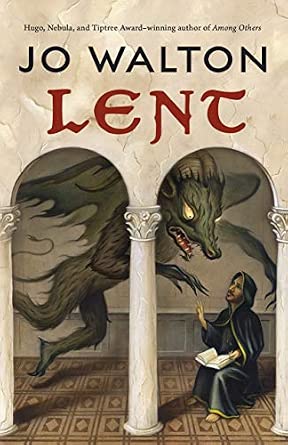
Upright, he scowls threateningly at the demons surrounding him. They flee, leaving him alone. There is no fellowship in Hell, the only relationship possible is that of tormenting one another. Spite, Hell’s closest approach to joy. They can torment him, or he can torment them, that’s all. It makes little difference whether they are there or not. He can be achingly lonely in the presence of enemies. And Hell, unlike the stories they tell of it on Earth, is the abode of demons only, at least as far as he knows. If human souls are condemned, they must be somewhere else.
“Girolamo? Are you all right?” the Count says, and because he has never said it before, Girolamo can hear it, separate from the roar of iterated past and future that is breaking over him.
“Don’t eat with Piero, he will poison you,” he says, urgently, desperately, while he can. “You too, Angelo.”
They start to protest, and he sees their faces, the Count surprised and curious and Angelo indignant. He has never seen those expressions, not in this room. He has changed it, and the weight of repetition is lifting. He has free will, for the first time since the Fall he is free to act where it matters. He is still thoroughly aware he is that unbearable thing, a demon in temporary mortal form, cast out utterly from all hope of God’s love. He can still remember the other iterations of his life. But he no longer staggers before the echoing repetition. He has changed it. He has lifted the weight a little even by this tiny change. He knows what they said and did on every other occasion in this room, but not what they will say or do now.
“He brought me books from Rome. Appian’s history of Alexander!” She is carrying the volumes herself, and pats them eagerly as she speaks.
“How exciting,” Marsilio says. “You must let me read it.”
“Oh, it’s not philosophy, it’s just a chronicle of events,” she says, in a gently teasing tone. “I’ll pass it on to you when I’m done.”
“There’s philosophy in everything if you read it the right way.”
“Oh, I had a letter from Piero.”
“And did it contain philosophy?” Marsilio is smiling.
What he remembers is Michael’s shocked and terrible face, full of pain. His brother’s face. And then Hell, slamming into it, over and over.
Marsilio is reading through what Girolamo has been working on. He spent the first year after he remembered what he was, writing down everything he remembered of the six years that were to come, for the others, and to make a detailed record. Then he wrote about what else he knew of the further future, little more than hints of disasters to come. What good could it do for anyone to know of the more distant horrors he has seen? Christianity schisming and the two halves slaughtering each other furiously. Engines powered by fire roaring across Europe. Guns that fire rapidly, and men running across the mud towards them and dying. Jews, naked and trembling, old women, children, being pushed into ovens. He hates to remember them, and writes them down, in case. Pico, reading them, asked whether he was sure these were visions of the future and not memories of Hell. They are not, he is sure, because even in the worst of them there are signs of love and hope.
“About what happens with free will and our souls across these iterations, if we do different things? Consider Lorenzo. In every life you remember, Girolamo, he died in a state of grace, indeed in the higher hypostasis, the highest state a human soul can reach on Earth, purified, glowing. His soul would have gone straight to God. If in this life we had permitted him to kill Piero to save Florence, we assumed his soul would go to Hell for eternity. As it is, we assume he spent some time in Purgatory being purified before he could again reach the state he was in before. So, given this, we have free will. We can change. Our souls can, and their destination. But how many times is the ultimate fate of our souls in question? Can a soul be saved in one iteration only to be lost in the next? Or the reverse? Are our souls called back every time from bliss and safety once more into peril?”
Both of them look at Girolamo.
“Well, in Hell it is all and only like that, only worse. Anything you say, anything anyone says, is tinged with malice, and lacerates, intentionally or unintentionally. It isn’t like Dante says. He couldn’t have had those conversations there with Virgil. They’d have been constantly taking offence at everything each other said, and resenting it.” Girolamo shudders, and strokes the smooth glazed clay of his wine cup. He hates thinking about it.
“But Dante wasn’t damned,” Pico says.
“No. Maybe not then. But for those of us who are, it’s like that.”
“What if you said I love you,” Marsilio suggests.
“It would sound false and malicious, and would remind them of all those who did love them and are forever lost, or even that I might have once loved them and now hate them, or am indifferent to them, so that being reminded of lost love is pain.”
He remembers that joust so well he can almost smell it, the slightly spicy dust of Ferrara, Beatrice’s sickly lilac perfume, and their snack of grilled eel with the Ferrarese scroll-shaped bread. He can also remember the brown horse winning, and the black, and the grey, and the grey mare slipping and the horseman falling, and slipping but managing to keep his seat, and slipping and swaying and almost managing to keep his seat and then falling beneath the mare’s hooves, with Chiara crying out and his grandfather running onto the field to set his bone. All of these things, all of these memories, from different iterations of his life, in all of which he had done nothing but sit in the stand next to his family, watching. All these tiny changes, which led to no great changes. Eddies in the river of time.
“Get behind me, Satan!”
None of the art/writing on this site was generated by LLMs.
If you'd like to get in touch with me, check out my about page.
Follow me with an RSS reader to be notified when I write something.