

Annotations 
Pikachu’s Global Adventures
In such crossover character goods as Yu-Gi-Oh! and the ANA Pokémon jets, Japanese “cool” is traveling popularly and profitably around the world and insinuating itself into the everyday lives and fantasy desires of postindustrial kids from Taiwan and Australia to Hong Kong and France. This global success in transactions of images, imaginary characters, and imaginative technology marks Japan’s new status in the realm of what is sometimes called soft power (by Joseph Nye and others) and cultural power (by the mass media and government officials in Japan). This is a recent development, because even when Japan was most economically strong (through the Bubble years and at the height of its economic superpowers in the 1980s), its influence in the sphere of culture (images, ideas, films, publications, lifestyle pursuits, novels) penetrated little further than its own national borders. Curiously, though, along with the bursting of the Bubble, Japan has started to soar in one domain of its economy: creative goods whose value outside (as well as inside) the country is taking off like never before. And, at the same time that Japan’s place in cultural production rises in the worldwide marketplace, so does the hegemony once held in this sphere by the so-called West and particularly the United States begin to erode.
What interests me in these new global flows of Japanese children’s properties are the ways in which fantasy, capitalism, and globalism are conjoined and (re)configured in toys like Yu-Gi-Oh! trading cards and an ANA Poké-jet. The lines between these categories blur here, for whereas Yu-Gi-Oh! is more clearly a play product marketed to youth, a Poké-jet extends the meaning of “playtoy” in a new direction by (also) being a clever marketing strategy to extend profits for a capitalist corporation not usually associated with children’s entertainment. Further, according to some people at least, both these products are also vehicles of/for Japan’s “cultural power”—high-tech fun goods that, in traveling popularly around the world these days, are spreading Japan’s reputation as a first-class producer of imaginative fare. As a group of American kids (aged eight to eighteen) told me in 2000, the associations they hold of Japan are neither of kimonos, tea ceremonies, or kamikaze pilots nor of Honda, Toyota, or Mitsubishi but of Nintendo video games, Sony’s Walkman, and Pokémon. It is as consumers and players of Japanese manga, anime, video games, trading cards, and entertainment technology (Walkman, Game Boy, Sony PlayStation) that postindustrial youth today—an ever-increasing demographic in consumerism more generally—relate to Japan.3
techno-animism is a style that is deeply embedded in material practices of commodity consumerism. In reenchanting the everyday world (ANA jets that convert to a flying Pikachu), this linkage also reproduces a consumer capitalism tied to commodities that stand (in) for fun, release from everyday stress, and the warmth of intimacy and friendship (one is surrounded by “friends” when traveling on a Poké-jet). This is where polymorphous perversity (detached from fathers) and techno-animism (reconfiguring intimate attachments) join together.13 Plugging consumers into cutely fun techno-toys, properties like Pokémon provide access to imaginary worlds but also map the desire to find meaning, connection, and intimacy in everyday life onto commodified apparatuses (goods/machines).
Since the 1970s the cyberpunk author William Gibson has written Japan into his novels as the frontier of the new cyber world order. His sci-fi descriptions of Japan bleed into those of the world at large: a landscape in which borders dissolve, bodies continually transform, virtuality is more real than reality, and space simultaneously collapses and opens up into multiple dimensions. This is a world not unlike that described by Michael Hardt and Antonio Negri in Empire (2000), their study of global conditions at this moment of the millennial crossover. Today’s empire, they say, is a place where the ideology of the world market dovetails with that of postmodernism, differences proliferate, and mobility, diversity, and mixture are the very conditions of possibility (for communities, corporations, existence). Space is always open, modernist distinctions (private/public, inside/outside, self/other) disappear, and power is exercised not through nations or disciplinary institutions (family, state, school) but through international bodies and corporations (the United Nations, the World Bank, Microsoft, CNN). In this era of globalization, flexibility and portability are keywords for the ways in which bodies, capital, and material objects continuously move through and inhabit (shifting) space.
Flexibility and portability are also signature features for the new wave of Japanese children’s properties circulating so widely in the global marketplace. In the imaginative universe of this play empire, bodies of multiple kinds are broken down, recombined, newly invented, and fluidly transported (teenagers morph into cyborgs, virtual pets are raised on digital screens, ANA planes transform into Pokémon theme parks). This construction and characterization of play have been fostered by specific conditions and trends in postwar Japan. They are also resonant with the millennial era/world of empire in which postindustrial kids across the world are navigating the dispersals, fluctuations, and deterritorializations of everything from bodies and identities to relationships and basic sustenance. This book will examine how Japanese play properties articulate (in Stuart Hall’s usage of the word) these different planes—postwar Japan/millennial empire, play/capitalism, culture/commodity, globalism/localism.
This fantasy fare, I believe, is best regarded as a type of currency: goods that are bought and sold. At the same time, it consists of imaginary creations that both extend and collapse the materiality of play products into other dimensions. To borrow from Walter Benjamin (1999), this is a business of enchanted commodities. Play creatures like pokémon are packaged to feed a consumer fetishism that, in this age of millennial and global capitalism, penetrates the texture of ordinary life in ever more polymorphous ways. Circulating in Japan by means of fads, these have been—starting in the 1970s and peaking again in the late 1990s—a “cute” (kawaii) craze (also called a “character” craze) grafted around lines of merchandise such as those of the company Sanrio, known for their bright colors, miniaturization, and hordes of small articles as well as other pop cultural forms generally associated with girliness, fun, and childhood, such as writing in a childish script known as burikko. Today some white-collar workers (sararman) even adopt a burikko style of endearing cuteness in an effort to retain jobs in this recessionary climate. Characters, often designed to be cute, come in toys, backpacks, lunch boxes, clothes, theme parks, telephones, wristwatches, bread, snacks, key rings, and icons promoting everything from neighborhood meetings and government campaigns to banks and English schools. These commercialized creations—including Doraemon (a blue robotic cat), Kitty-chan (Sanrio’s femmy white cat, also called Hello Kitty), Tarepanda (a droopy, cuddly panda), and Pikachu—sell, and are sold by, a number of commercial interests by projecting an aura of fancy and make-believe.
Okada Toshio, a game designer and lecturer at Tokyo University, believes the quality captured by play goods like Pokémon is “cuteness,” which, because Japanese are particularly skilled in crafting it and because it is “one thing that registers for all people,” may well be the nation’s resource for “working foreign capital in the twenty-first century” (Yamato 1998:244). And, as described in the economic journal Nihon Keizai Shinbun, it is the “expressive strength” (hygenryoku) of Japanese traditional arts that is fueling what is becoming the “international common language” of manga, anime, and video games today. The market for these three industries has surpassed that of the car industry within the past fifteen years in Japan, forming an anime, komikku (comic), and game industrial zone (for Japan, what the Silicon Valley is for the United States) that may well be the root of the new twenty-first century’s center for culture and recreation (Nihon Keizai Shinbun 1999:3).
For still others, what is both distinct and compelling about a fantasy product like Pokémon is the “Japanese sensibility” (yasashisa) it captures that, characteristic of Japan’s spiritual culture, is transmitted to present-day kids and helps them to face the next century (Nagao 1998:142). This inter-mixture of the old (spirituality) with the new (digital/virtual media) in Japan exemplifies what I have earlier dubbed techno-animism: animating contemporary technology and commodities with spirits and recuperating cultural traditions with New Age practices. Nagao Takeshi, the author of a book on Pokémon, explicitly uses the Japanese word—ykai—for spirits and otherworldly beings of various kinds to identify the hordes of pocket monsters that, inhabiting the virtual terrain of Poké-world, are what players strive to capture in operating the game (137). The latter are artificially constructed, but their “fakeness” or “non-aliveness” is not so different from that of the traditional ykai, whose meaning and value in the cultural cosmology are those of a (polymorphously perverse) being that hovers between two worlds—one, phenomenal, the other, more noumenal (189). In both cases—the game space of Pokémon and a cultural milieu that accommodates ykai—an animist logic prevails in which the borders between human and nonhuman, this-worldly and otherworldly, are far more permeable than fixed.
Different, in this sense, from the common Euro-American worldview—where humans center existence and the distinction between life and death is more definitively conceived—this also constitutes a more general aptitude in daily Japan for animating, spiritualizing, or altering the material world that is at once playful and deadly serious.
The Buddha in the Robot, a robotics professor at the University of Tokyo and also a Zen Buddhist priest (Mori 1981).
Similarly, Hello Kitty, one of the biggest and most global icons of Japanese cool today, was given an English name when first designed in the 1970s because—as its creator has explained—anything American was faddishly popular in those days, but few Japanese had the means to actually travel to the United States themselves. Making Kitty-chan part American gave this character greater appeal to Japanese (and perhaps global) consumers. And “playing” with identity has only continued. In 2001, Sanrio officially announced that Kitty now had a last name (White), making this most profitable and popular of Japanese playtoys a mouthless cat with the name Kitty White (McGray 2002).
a book on Pokémon, the anthropologist Nakazawa Shin’ichi (1998) has written that Japan is a world leader in products that not only capture children’s imaginations but also yield enormous profits—a combination that may seem paradoxical (figure 5). Yet it is precisely this paradox, he concludes, that “encapsulates the direction in which capitalism is headed today” (personal interview, May 2000). Indeed, we live in an era in which the imagination plays an increasingly important role in the (global) economy and is ever more embedded within, and a stimulus for, commodification. By crafting playware that not only appeals to the needs and desires of postindustrial kids but also tethers the latter to a New Age capitalist imagination, Japan is emerging as a toy maker and toy marketer of millennial times.18
More than anything, according to Nakazawa, two qualities in Japanese play goods like Pokémon account for their admixture of popularity and profitability. One is what he calls their potential to “heal”; the other is their portability (as in games played on Game Boys), so in sync with today’s mobile lifestyles. But joined to these and spurring the capitalist imagination that Nakazawa intuits (but leaves unexamined in his own work) is a third quality I call the addictive frenzy fed by Japanese toys. As imaginary playscapes that polymorphously change form and perversely go on forever, they incite a consumer appetite to play more and more, and to buy more and more of the merchandise sold in the marketplace.
For these two qualities of healing and portability, according to Nakazawa, a play product such as Pokémon both mimics and exceeds the world in which it is used. It embodies (and enhances) the nomadic lifestyle of a postindustrial subject but also magically “heals” the stresses of living in an environment with little time or space for the imagination. And, ironically (or not), the form this takes—a commodity that is bought and sold in the marketplace—is highly addictive. Not only are these play creations promoted with all the savvy of the most current marketing strategies (where what is au courant is the very latest—and most changeable—in fashion style), but the very logic of fantasy itself is one of endless possibility. As in Mighty Morphin Power Rangers, characters continually alter/enhance/remake the parameters of their bodies/powers/identities by appropriating a range of weapons/outfits/spirits/tools. Everything is at once fluid and boundless in this imaginary universe: one constituted by a host of particles and elements that, by being rearranged or replaced, generate ever new entities and relationships. And the desire this feeds is to expand the possibilities even further, whether the commodity/play form is Yu-Gi-Oh! trading cards, Sailor Moon comic books, or Pokémon Game Boy games.
Enchantment is continual here, but so is the impulse to keep changing and acquiring more and more of whatever it is that constitutes the core of the fantasy—whether more pocket monsters (to win the game in Pokémon), more action figures (as in the newest version of the heroes in Power Rangers or Sailor Moon), or more virtual pets (as in purchasing a different tamagotchi or resetting the original to “birth” a new pet). Players become addicted to the rush of transformation, and this itself feeds a capitalist imagination, one dressed in commodities of limitless play and possibility. But, true to the principle of capitalism, the desire to expand further (by acquiring more powers, more pokémon, more wins in battle) eludes ultimate closure or satisfaction (there is always more—of whatever—to obtain/attain). In this way, playing with a Japanese fantasy good both replicates and reproduces the very conditions of postindustrial capitalism (fragmentation, speed, flux, flexibility), with its effects on subjectivity (anxiety, atomism, and alienation).
The fantastic as I conceive it is the constant condition of Japanese modernity in all its contradictions and fluidity. I would even extend this argument to suggest that to some degree modernity in general is born of fantasy and that any “doubling” perceived within it is between modernity as “reality” and modernity as “imaginary.” Whether configured as negative impediment to national-cultural consolidation or as positive site of alternative new worlds, the fantastic allows the modern to be thought. In a sense, modernity itself is phantasmagoric; it ceaselessly generates that which is a la mode by consciously imagining difference from things past. Embodying transformation, a change of modes, modernity is akin to the root definition of bakemono, a “thing that changes form.” (Figal 1999:14)
As Benjamin also believed, the very forces fragmenting people’s lives—the spread of technology and jobs that split people’s bodies and labor into discrete units—contain the potential for recouping their “capacity for experience.” Whereas other scholars such as Max Weber argued that modernity brought rationalization, Benjamin thought that under the surface of rationality the urban-industrial world had become reenchanted on an unconscious level. Mythology did not disappear in this age of technology but, rather, became rooted within technology itself. This phenomenon resulted from what he believed to be a creative potential within industrial production, as well as the imaginative effect on consumers of the spectacular display of goods (as in the Parisian arcades) as a kind of phantasmagoric “dreamworld” (Benjamin 1999; Buck-Morss 1997).
Benjamin observed this effect in the way that industry and technology were presented as if they were new gods, capable alone of producing peace, progress, and happiness. New department stores arranged goods in carnivalesque dream form, and urban space became transformed by (and into) markets for selling dreams. While such mystification drew people into a system of industrial capitalism that also exploited, isolated, and alienated them, Benjamin (unlike Marx or Adorno, his constant critic) thought there was, or could be, something redemptive in the capacity shown here to hold on to the imagination. An example of this creative potential from Benjamin’s time, nearly a century ago, is the mimetic capability he saw accruing to the new technologies of photography and film. Just as young children “mimic” the world as a means of exploring (through creatively replaying) it but lose this ability as they develop language-based cognition, so, too, does industrialization, with its fixation on “objective” science and facts, weed out mimetic play. Yet film and photography offer a means of recouping this doubly lost quality: of mimicking the fragmentation, for example, of bodies and space brought on by new labor regimes by showing it in slow motion, close-up visual detail on the screen. Seeing the effects of industrialization replayed for them in a photo or film (such as Charlie Chaplin’s routines in silent films) opened the possibility not only for humor but also for recognition, reflection, even political critique. In such ways, technical reproduction can give back to humanity that capacity for experience that technical production threatens to take away (Benjamin 1999; Buck-Morss 1997).
shita Eiji (the author of a book on the global boom in Japanese mass characters today) sees a distinctively Japanese aesthetic in the mass mythmaking of the early postwar era that has flourished to the present day. Measured less by the realism, flashy effects, or happy endings of Hollywood and Disney, made-in-Japan tales (in film, television, comic books, animation) grip their audiences with an emotional power that registers as “true” while still remaining a fantasy. The mythological composition is crucial: how the story and characters weave an alternative world that evokes deep responses in the audience—yearning, fears, anxieties, desires.
This genesis scene reminded me of a similar one in a cyborg myth that had been as intensely monumental for the Euro-American imagination: Frankenstein by Mary Shelley (originally written in 1818). In this story, also about a man-made creature built in the lab of a scientist that comes to life at the flip of a switch, the contrasts are much more striking. Seen as a monster, Frankenstein is an outsider, threat, and eventually killer of humanity: a bleak warning about the dangers of transgressing the human-machine border.16 Atomu, with his boy body and sweet nature, is radically different. With a goodness as superlative as his strengths, he personifies the cyberfrontier as nonthreatening, uplifting, and bright.
Nomadicism—what characterizes the postmodern world more than anything, according to Deleuze—is the trope of everyday life in Tokyo.
One family, one TV has become one person, one TV. One family, one telephone has become one person, one telephone. The living room where the telephone and the TV were the center of the household is buried in dust. The household’s members are in their own rooms each watching their own TVs. They communicate with the outside world using their portable phones. To begin the day, each gets up when he or she has to, heats up some ready-to-eat food, or stops by a fast-food restaurant to eat a “breakfast set.” The family core of the household is now fragmented in time and space to a shocking degree. (Tomie and zawa 1997:5, quoted in McCreery 2000:255)
The press and cultural critics have devoted much commentary to this feature of millennial Japan. Japanese people are said to spend more and more time alone, to be ever more focused on their own needs and desires rather than those of others, and to be socially detached from the kinds of relationships and commitments that are thought to have once grounded the culture (family, community, nation).
This phenomenon is akin to what Deleuze and Guattari (1987) call “deterritorialization”: the effect, in part, of global capitalism with its flows of images, finance, ideas, people, and goods across geographic borders and of New Age technologies that enable high-speed travel, global communication, and virtual reality (leading to the compression, as well as fictionalization, of time and space). If a more territorialized notion of place once anchored people (to neighborhoods, villages, a nation graphed by its rice fields, Mount Fuji, and island status), how, we might ask, do postindustrial Japanese connect to one another and claim identity when they spend ever more time on the move?
Shut-In Youth (Hikikomoru Wakatachi by Shiokura Yutaka, 1999),
Experts on the condition say that hikikomori are characteristically sad, stressed, and without hope (lacking the will to live). A study by the Ministry of Education on school refusers points out, concerning this related syndrome, that children who retreat to their rooms are not necessarily doing so because they want to stay home. Rather, they cannot find a “space of their own” in the world outside—the environment of school, juku, and postindustrial performativity (the regimen of endless study, endless memorization, endless exams) that exacts and extracts such expenditures of body and soul. For Shin, playing guitar seems to have been such a personal “space” or “dream” that fueled his passions as he labored dutifully at school. But, as in many of the other accounts in Shut-In Youth, when Shin entered high school, his parents forced him to give up the one thing he loved, the guitar, to devote himself single-mindedly to study. As another hikikomori related: “My parents always asked me: Are you working hard at school? They never asked whether I was enjoying school. My parents just ordered me to sleep, eat, and study. And, if I didn’t answer them, they’d ask, ‘Don’t you understand our love?’ ” (Shiokura 1999:59–60).
Using the all-encompassing trope for the malaise of these millennial times, Tomita of Friend Space says the root of this problem is “communication”: “These kids want to communicate but can’t.” By communication he means something both personal and interpersonal: an ability to form intimacies with others and with(in) the self as well. Hikikomori are socially constipated, a condition that comes less from any deficit or predisposition in the child than from an environment railroading them into a single mode of identity or engagement. Tomita concludes, “It is better to say, not that these kids have shut themselves in, but that they have been shut out by society” (Shiokura 1999:23).
Murakami Ry’s novel Kyseich (2000)
For Marx, alienation is always provoked by an estrangement in the labor process. By working under conditions one-sidedly fixated on producing profits, the worker, as well as his world, is reduced to the abstract currency of a money economy. In the case of postwar Japan, productivity has also been measured, and fed, by academic performance: an extreme value placed on admission into prestigious schools that has been the ruling ideology of and for middle-class kids. In this fetishization of test scores and academic records, children are treated as machines. Programmed in one register, they are far less schooled, or encouraged, in the development of other human capacities (such as interpersonal communication with others or the cultivation of personal hobbies).
But even today, the world of millennial Japan is hardly dominated by estrangement alone. Or, to put this differently, intimacies and enchantments also abound, often appearing in the very circuits of atomistic existence that seemingly promote alienation. This is the world of personal electronics, designer fashions, and character “cuteness”: a plethora of things, machines, and fantasies that, closely affixed to people’s bodies and interwoven into the fabric of their everyday lives, has an animating effect on consumers. This is the allure of commodity fetishism, Marx would have said: attributing to goods the “life” that has been extracted from the laborer. But dismissing the fascination held by such new-wave products as Game Boys and wireless multisystems (cameras/phones/e-mail/Internet) as no more than false consciousness—the ruse of capitalism to disguise its exploitation under the cover of seductive commodities—can only take us so far here. As Benjamin more persuasively argued, the enchantments held by consumer/techno goods work on people in specific ways, even if (or precisely because) they come linked to a socioeconomic system that is also alienating. This, surely, is the case in Japan, where, in an environment of intense work demands, individualization, and materialism, the reification of life is extreme.
As hira points out, the mono no katari no hitobito is concerned with her place in the world and aims to elevate it by acquiring brand-name goods. Acquisition gives the person a sense of control, as does a propensity to classify everything. Life is managed by scrupulous cataloging: shoes, kitchenware, meishi (business cards), and phone friends. If something does not fit this pigeonholing, it either is gotten rid of or else provokes a problem—such as the difficulties experienced with real people, some of whom lack the passion for material goods of the mono no katari no hitobito. With the logic that buying and assembling goods will make one happy, things are used to “power up” and concretize the inner self. This mind-set is commonplace today in Japan, where a consuming public borrows the language of commodities to describe everything from personal identity and worth to companionship, intimacy, and interpersonal relationships. As hira notes, material wealth was the “Japanese dream” for postwar reconstruction. But the “treasures” of these earlier years (refrigerators, washing machines, color TVs) have long been realized, and the “dream” has nowhere else to go (1998:230–36). What Japan is now experiencing is a “pathology of abundance” (the title of his book on the subject, Yutakasa no Seishinby), generating the condition of “people who talk about things.” Its symptoms are an intimacy with goods coupled with a deficit in interpersonal closeness.
This is also true of a fad that, blooming along with Japan’s postwar prosperity in the 1970s, has peaked again (since 1997) in the millennial years of post-Bubble distress—a craving for “cuteness” as well as cute characters (Kitty-chan, Pikachu, Doraemon, Miffy) that adorn everything from backpacks, toy figures, and comic books to phone straps, key chains, and adult-targeted fashion. Emerging from the children’s entertainment industry that, in the 1970s, produced toys out of mass-media characters (cartoons, comic books, television shows), the character business started taking off on its own when Sanrio came up with its Hello Kitty line in the 1970s. Bred, in this case, not from a media production but as an entire line of adorable consumer goods (stationery, hair clips, tea cups, lunch boxes, pajamas, umbrellas), the mouthless kitty cat triggered a fashion in both characters and cuteness (generically referred to by the adjective kawaii, for cute). Although it was initially targeted to young girls (shjo)—and fostered by them in such fads as hentai shjo moji (a round, girlish form of handwriting)—cuteness exploded into a national obsession. In the 1980s, commercial businesses started adopting cute characters in promotional advertising. ANA airlines, for example, turned around a lagging ski campaign by employing the American character Snoopy, and JAL followed suit by using the character Popeye to target young women for tour packages. By the late 1980s, banks had adopted the practice of utilizing characters as a type of company logo and insignia on bankbooks (Dents 1999), and by the 1990s, personalizing cell phones with character straps (for adult men, the favorite is Doraemon, the blue robotic cat of the long-running anime and manga series) had become a common practice.
Speaking of the recent craze in character/cute goods, an advertising executive describes the relationships formed as both kinlike and (inter)personal. Whether a Kitty-chan key chain, Doraemon cell phone strap, or Pikachu backpack, these commodity spirits are “shadow families”: constant and reliable companions that are soothing in these postindustrial times of nomadicism, orphanism, and stress. Someone else in the business states this more sharply: “Parents die, but characters remain forever” (Riri Furanki, cited in Burn 2000:15). Concurring, the authors of a recent book on the character business state that characters are the “lifeline of human relationships” in today’s high-growth information society and serve as the totems, protectors (omamori), and “utility symbols” of its citizens (Hashino and Miyashita 2001:4–5). With seeming pride, they label Japan a “character empire,” noting that no country in the world has become as thoroughly inundated—both economically and culturally—with character merchandise as it has.
The Reasons Why 87 Percent of Japanese Like Characters
the appeal of Japanese play goods can be characterized by two main qualities—polymorphous perversity and techno-animism—that help explain their cachet as the cutting edge of trendy “cool” on the marketplace of kids’ entertainment today. This is fantasy-ware with a mass array of spirits and parts (techno-animism) that continually transform, come apart, and recombine in a variety of ways (polymorphous perversity). Further, such a logic of play has been packaged in forms that suit the tempo and lifestyle of these postindustrial times. Gameware is portable (making access convenient and continual) and adjustable for personal use (anything can be listened to on a Walkman), while the fantasy making conjures up playmates that “heal” the ills of materialism, all the while generating an addictive frenzy that literally buys into the same thing, of playing, wanting, and buying more and more commodified stuff. In this chapter I have laid out some of the socioeconomic factors and events that have shaped the national mood in Japan at this moment of the millennial crossover and can be traced not only in the “pathologies” of the era—Aum Shinriky, social shut-ins, criminal youth—but also in the trends in producing, accumulating, and bonding with “cute” play commodities that define the subject of this book.
Collapsing fantasy into ideology, this mythic superhero stood for an imaginary Japan/ese that, as Benedict Anderson (1983) has argued about the role played by mass media in producing the nation through an image collectively shared, was a product of the burgeoning mass culture arising through the channels of television, manga, and animation in Japan’s early postwar years. A sign of the future, Tetsuwan Atomu also incorporated something of Japan’s preindustrial traditions: an animistic belief system in which the border between human and nonhuman is viewed as far more porous than fixed. A legacy of Japanese folklore—filled with tales of hybrid, morphing, and strange beings (human cranes, warriors born from peach pits, snakes that turn into women)—and Shinto-inspired animism, where everything has a spirit from the air and the wind to rocks, rivers, and humans, the amalgamation of robot and humanness here is a sign of both Japan’s future and its past.
Fordism—that is, the standardized, large-scale production ushered in by Henry Ford’s first car plant in Michigan in 1913—spread internationally after 1945, forming mass markets and absorbing the mass of the world’s population (outside the communist world) into the global dynamics of a new kind of capitalism hegemonized by the United States. By the 1960s, however, this hegemony was being challenged by the recoveries of West Germany and Japan, the saturation of America’s internal market, and the intensification of international competition. According to David Harvey, 1973 marks the watershed year when the political economy of late twentieth-century capitalism was radically transformed from Fordism to post-Fordism, or what he calls “flexible accumulation.” As Harvey (1989) puts it, the rigidity of Fordism made it increasingly less able to sustain the inherent contradictions of capitalism. What was needed instead was a system with greater flexibility to match the uncertainties of the labor market.
Moving away from the Fordist model of mass production, production was now geared to the vagaries of demand (by means of the kanban—just in time—system), with workers trained to move between tasks. Thanks to multiple skills and job rotation, employees became increasingly identified more by the company they worked for than by a specific job. Group identity was fostered in other ways as well: all workers at Toyota, Nissan, or other big companies now wore the same uniform and badge no matter what their rank, for example, and separate cafeterias and reserved parking for management were abolished (thereby reducing the gap—so striking in U.S. companies, particularly in salaries—between workers and management). In addition, corporate principles of lifetime employment and all-company unions (in which management and labor work together) became popular, as an ideal if not always a reality, in medium-sized and large companies starting in the 1950s.
Frederik Schodt notes: “The man-robot symbiosis that Mazinger Z symbolized helped solve an old problem in robot fiction—the problem of personifying the machine while still preserving its mechanical identity. When the robot became, like a car, a machine that could be jumped in and driven, it had a powerful appeal to young boys” (1988b:83).
Kamen Raid’s fighting skills (the Raid punch and kick
As Fredric Jameson (1984) characterizes the cultural logic of late capitalism, postmodernism revels in a heterogeneity of styles that crossbreeds historicities, cultures, and artifacts in a pastiche aesthetic. Such a coding is evident in Power Rangers, with its jump-cutting between stylized action scenes shot in Japan and American teenage dramas filmed in Hollywood. But this aesthetic of fusing styles from different cultures, histories, or genres is also apparent in the Japanese original of the Ranger series. In Jy Renj, “normal” teenagers move between futuristic transformation and traditional martial arts, and their bodies bleed with prehistoric dinosaur spirits as well as New Age cybermachines.13 Writing in the Village Voice, Erik Davis calls this “future-primitive” (figure 19), an aesthetic strikingly different from that upheld in Hollywood. “Unlike America’s reigning ideology, which holds that ‘good’ effects—like Terminator 2’s morphing—are simulacra dependent on the latest technological developments, the Power Rangers present an old-fashioned tacky futurism that is sufficient unto itself” (1994:74). Davis traces the “future-primitive” to Godzilla, in which technology figures more prominently in the story itself—transforming a prehistoric beast into a beastly nuclear weapon—than in the high-tech film/television production upheld by Hollywood.
Hideki was playing next to us, making battle and flying sounds with the renj chriki gattai robo (the superpower collateral robot on the renj series). Immersed in his fantasy play, the child kept retrieving other equipment from a huge box: a dagger sword, a “king blaster,” a Yellow Ranger.
Just as rich as the imaginative world Hideki entered was the abundance of material goods he acquired. A vice president at Bandai America articulated this principle as the cardinal axiom of his business: “The show is the fantasy, and the toy is the material realization of that fantasy for the child to play with on his own.”15 With Rangers, the fantasy is so constructed that it is materialized in a wealth of commodifiable bodies, tools, and “spirits” with a shelf life that is breathlessly short. The principles involved, then, are those of fetishistic consumption as well as flexible production, fulfilling Marx’s insight about the constant (re)creation of capitalist desire whose satisfaction is forever deferred. In Benjamin’s words, Power Rangers is an enchanted “fairy scene” in which commodities are sold as fantasies and myths. And transformation is the key to this postindustrialized dream: a mythic trope that serves the interests of capital and shapes the fantasies of kids at this moment of the twenty-first century.
The novel Kitchen, for example, by the self-identified shjo writer Yoshimoto Banana,
Many girls read their own identities or desires into the doll (“queering” her heterosexuality, for example, or “seeing” a white Barbie as black) rather than simply accepting the raced/gendered/sexual identity she comes packaged with. But I am also talking about power here: packaging in a way that sutures particular places and faces (American, white, male) to what is accepted, and expected, as standard. Counting on seeing “oneself” reflected in mass culture is the chauvinism of the empowered. And when the only identity available is different from one’s own, viewers must either find a way to position themselves in the fantasy or be excluded.
Virtually biologic (or biologically virtual), the tamagotchi realizes Bandai’s corporate policy for the late 1990s: creating toy merchandise that “transcends time and space, and goes beyond national boundaries” (Bandai Kabushikigaisha 1998:5). The company’s aim, both in the products it sells and in the markets it sells to, is to stretch borders. Because its business of character merchandising “depends on knowing to which specific groups a particular character is likely to appeal” (4), the goal is to make characters that will appeal to as broad a consumer base as possible. In its corporate guide for 1997, Bandai uses the tamagotchi as an example of this very principle. Targeted first to senior high school girls in Japan, it attracted a much wider fan base in both the domestic and global marketplace than previous products. As Bandai says proudly: “These characters have now become the close friends of many, many people” (4).
In Modernity at Large (1996), Arjun Appadurai argues that the world we live in today is characterized by the new role that imagination plays in social life.
Émile Durkheim analyzed in his Elementary Forms of the Religious Life (1961)—
For Appadurai, the operation of imagination today is distinguished by the conditions that David Harvey (1989) and Fredric Jameson (1984) attribute to late capitalism and its cultural state of postmodernism. In an economy of continual downsizing, outsourcing, roboticization, and flexible accumulation, people are constantly driven, out of need or desire, to move and remake their jobs, identities, relationships, and communities. Ruptures to self and social networks occur frequently, and distance and alienation are commonplaces of everyday life. Technology, too, is continually altering and reordering the dimensions of human existence, remaking bodies and remapping the ways in which people make a living and experience the world. As machines become embedded ever more deeply into life and even flesh, the line between human and nonhuman increasingly blurs.
Just as the print media were a prerequisite for imagining the nation at the moment of modernity, as Benedict Anderson (1983) has argued, electronic media produce the images that imagine community, reality, and self in today’s postmodern era.
Not surprisingly, adults are increasingly becoming consumers as well as players of sof-tronics. Bandai, for example, has a service that thirty thousand sararman subscribe to called “Love by Mail” that sends messages from make-believe girlfriends to the subscriber’s Internet-enabled cell-phone. And Takara’s Aquaroid, released in 2001 at a price of $750, is a solar-powered robot that—living in an aquarium of water and mimicking the movements of a jellyfish (by moving up and down and side to side)—is a big seller among sararman for its hypnotic and soothing effects. In both these cases, a form of companionship comes from an other that has been artificially/virtually constructed, is a commodity sold in the marketplace, and has been designed to please and heal the individual (as player and consumer).
The principle here of mastering nature by the imposition of scientific order stems from a modernist worldview, one that Japan subsequently adopted as well, where it was similarly tied to the birthing of the modern nation-state and the rise of capital accumulation that fueled the Industrial Revolution: “In the sphere of culture the many forms of collection that were practiced during this period developed in part as the image of that accumulation, and as its legitimation. The systematizing of nature carries this image of accumulation to a totalized extreme and at the same time models the extractive, transformative nature of industrial capitalism and ordering mechanisms that were beginning to shape urban mass society” (Pratt 1992:36).
In the last two sections of Poketto Monst Zukan (public lectures and staff interviews), the discourse significantly shifts its emphasis from conquest, discovery, and accumulation to exchange, communication, and care-giving. The objective of getting pokémon is played down by the creators of the game, who play up instead the fun of exchanging monsters, trading information, and bonding with pokémon. As Watanabe (the programmer) states, the game was designed so players can give their pokémon personal names, and “pokémon remember the names of the parents who have raised them” (Asupekuto 1997:141). Nishida (the graphic designer) adds: “Battles are interesting, but I’d like you to think not just of winning and losing but also of how to be nice to the pokémon you’re raising” (142). For his parting words, Tajiri advises children to “carry the monsters you raise around with you everywhere” and “play without any limits to how you play, forming partnerships with many pokémon as well as many friends” (143). Mimicking the logic and discourse of tamagotchi—a play of raising virtual pets—Pokémon takes this to a new level of exchanges, information, and communication with “friends,” both virtual and human. This is the essence of “Advice for Battles and Communication Exchanges,” the section that lists the following as pointers for conducting trades: “Always exchange with someone; after you’ve exchanged, you can play by yourself; give or lend what you’ve raised to another friend; give a pokémon that you’ve personally named to a special friend; try to create dramas apart from the game itself; hang in there until the end of the game; follow the rules; make a lot of friends” (123–28). So acquisition—of knowledge, territory, pocket monsters—moves to communication and friendship: a fusion of capitalism, “soft electronics,” and sociality.
In Marx’s classic formulation (1977), capitalism is an economy based on the estrangement of labor. Work is sold for a wage, and the surplus labor extracted from one class feeds the profits of another. Transforming what Marx believed was the essence of human life (“species being”)—labor—into a thing used to produce and purchase commodities, this system turns everything into a currency of exchange. Life, including people and the relationships between them, is thingified in the process.
An antithetical economic system is one anthropologists have identified as gift exchange. In his canonical work on the subject, The Gift (1967), Marcel Mauss describes communities in which labor congeals into gifts (as opposed to commodities) that are exchanged between individuals and groups rather than being transacted through money. The principle here is not self-interest, accumulating goods for oneself. Rather, the aim is to reciprocate with other goods (rice, beer, wives) and, through this exchange, establish bonds between persons. Whereas in capitalism relations are used to produce things, in gift exchange things are used to produce relations.
Japan today is a country fully embedded in capitalism. Its national goal, as structured by postwar policies, has been material prosperity fueling (and fueled by) personal consumption. Yet Japanese national culture has long been grounded in an orientation toward the collective: groupism, interrelationality, communalism. It is the erosion of precisely these values in recent years that is often linked to Japan’s current problems (everything from the economic recession to the social pathologies of schoolroom collapse, refusal-to-go-to school syndrome, the sarin gas attacks of Aum Shinriky, youth crime, and “amateur prostitution”). As consumer capitalism escalates, nostalgia appears for what Marilyn Ivy (1995) has called the “vanishing” of traditional culture, invented or not: a time and place in which not material things but human relationships mattered most. Still, traces of what is considered the traditional Japanese cultural fabric are seen in contemporary times, including a rabid engagement in gift exchange: everything from the institutionalized gift-giving seasons twice a year to the ritualistic purchase of omiyage (souvenirs) from even one-day outings to local hot springs. Such gifts are exchanged with an assortment of people, including landlords, neighbors, coworkers, and relatives, with whom one has social and economic relationships. I myself have been the beneficiary of endless gifts, including a ten-kilo bag of Japanese rice airmailed to me from a friend in Tokyo as a reminder of our friendship (and the time we spent eating what she was sure I missed in the States, Japanese food).
The transactions of gift exchange reflect the bond they express as well as the giver of the gift. In some sense, one is giving oneself in the exchange: what is materialized in the form of a thing that is also (as in gifts given to a god) a personal sacrifice. As Mauss pointed out, it is this element of gift exchange that makes what is economic (building the social relations on which life depends) also moral, even spiritual. Things given in exchange are inalienable in that the gift retains something of the giver, such as the person’s name, as in the kula ring studied by Malinowski, even though the giver parts with it.11 This is the meaning of the gift and the reason its symbolism is so powerful; relations between people are built on exchanges of self. By contrast, in transactions dictated by money, things or goods are alienable from the self (as in selling one’s labor for a wage and buying goods at a store) and are traded according to the value of the market rather than that of social relationships. Commodities take on a life of their own, producing a very different type of cultural ethos and logic. It is the individualistic desire to own and accumulate that drives the economy now, and material things are not merely the means to an end (more spiritual and social) but the end itself. Weber called this the iron cage (1987:181), when meaning and enchantment drop out of the capitalist machine. And Mauss decried the loss of morality in modern economies, in which the gift has been displaced by the commodity.
Ruth Benedict’s depiction of Japanese culture as anchored in contradiction (The Chrysanthemum and the Sword, 1946),
“People feel a lot of darkness today. As a defense, they retreat into solitary capsules. On the trains, everyone is immersed in their Walkman, manga, books they buy at kiosks: defense mechanisms used to maintain distance from others. Youth also turn to consumer products that allow them to relate to one another by maintaining the rule of silence” (Watanabe 1999:74). Pokémon offers a corrective to this kind of gloomy existence: a “route” (75) out of atomistic isolation to a brighter world beyond the self. Key here is the fact that the game is structured in such a way that players continually win. Whether it is through battles or matches or exchanges, a child keeps acquiring more pokémon and, in the process, receives (time and time again) what Watanabe takes to be the main message of the game: “You’re great!” (72).
To the best of our abilities, we have tried to prevent kids from feeling that these are characters coming from Japan. This is on account of localization. The reason is not because we want to hide the fact that Pokémon is made in Japan, but because we want to promote the impression that Pokémon are global characters.
Gail Tilden, Pokémon project coordinator, Nintendo of America, quoted in Hatakeyama and Kubo 2000:421
The slogan “Gotta catch ’em all” was selected by Hasbro to market the toy lines for this reason (Perry Drosos, personal interview). This motto worked so well that it was considered a marketing coup. The phrase not only was catchy (and the effect was heightened by putting it to music in ads) but also miraculously managed to gain approval of Federal Communications Commission censors, who prohibit the usage of injunctions (“You must buy this!”) in television ads directed to kids. “Gotta catch ’em all” does enjoin kids to consume, but because it also rehearses the logic of Pokémon play—catching all the pocket monsters—the slogan was allowed.
Rafoni also agreed that Pikachu was the lead symbol of the Pokémon operation in the United States. In taking this position, however, he is tacitly acknowledging that the pocket monster represents a crossover in what constitutes popular appeal in this country. The Disney model traditionally pushes strong males and weak, dependent females. But the Japanese have punched through these stereotypes to come up with imaginary beings that are post-gender, nonhuman, and completely apart from a reality-based universe. Because it is so unlike the fare they were raised with, many American parents have a difficult time getting either this concept or the deep attraction Pokémon holds for their kids.
Issuing the Pokémon movies in the States presented even more challenges; the alterations made to the first film required a vast outlay of energy (on the American side) and money (by the Japanese). Besides an entirely new musical score pitched to American tastes, the biggest shifts came in making the story line explicit, more black and white, according to Grossfeld, over the “shades of gray” preferred by Japanese in their storytelling. In the Japanese version, details and motives are left unexplained. But as Tilden (at NOA, who worked with Grossfeld in the U.S. production) told me, “American kids need to be hit over the head.”
“Our Wonder Bread heroes are not just turning Japanese, they’re becoming altered beings in a parallel aesthetic realm, with its own internal logic, myths, and ethics. And maybe their audience is transforming too. . . . The tykes currently addicted to the show may end up becoming a mass market for more mature and vital Japanese popular shows now shrouded in hipster subculture—e.g., anime” (Davis 1994:73).
The term casino capitalism has been used to describe the way in which luck has come to dictate monetary systems and the international financial system has come to resemble a gambling hall, making “gamblers of us all” (Strange 1986:1–3). As the potential for venture enterprise has expanded along with the growth of globalized markets, electronic media, and finance capital, the gaming room has become “iconic of capital: of its ‘natural’ capacity to yield value with human input” (Hardt 1995:39). Pokémon is the play version of casino capitalism: getting and trading commodities in a market highly dependent on fantasy, luck, and also skill. As my nephew said upon opening a pack of cards I had brought him from Japan, “Hey, Dad, I just got a twenty-five-dollar card.” For this eight-year-old, who, unlike other kids, never went to the hobby shop to cash in or barter his fortune, the value of this card was more imaginary than “real”: the mere fantasy of pretend transactions and accumulated wealth. Yet Mitch knew the “market value” for each card he owned, as assessed by his unofficial card collector guide that listed going rates according to a complex calculus (involving a host of factors such as the edition of issuance, whether the card was printed in Japanese or English, the card’s rarity, and the differential value for specially minted holofoil cards).
When I interned for two weeks during the summer of 1999, under a visiting professorship program at Grey Advertising, a New York firm, I was told that the key to good advertising is stripping a product down to its “core fantasy,” then “positioning” this fantasy to a target audience.24 Instructed in what is called psychographics, I learned that advertisers try to increase the “intimacy” consumers have with the brands that, like Starbucks coffee, are what companies stand for and what advertisers work to “nurture.” As distinguished from products that exist on the shelf, brands “exist in people’s minds” and thus stand at the interface between product and consumer. Making brands seem special and consumers feel as if they own them is the assignment handed to advertisers. By studying the lifestyles of various consumer bases (questioning how each spends time and money and profiling the psychic makeup as mapped by specific desires, anxieties, and concerns), advertisers use psychographics in crafting portraits for the products they are promoting. By “surrounding them with symbols,” advertisers thus give brands a “stage presence.” This is the “core fantasy” that, if effective, turns a product into a brand, a brand into an intimate friend, and a consumer into a loyal fan.
“We don’t know where this is, but it’s familiar.” What is at once anywhere and everywhere is a game setting that extends endlessly outward: to new zones, further interactions, additional conquests. “The blanks are filled in gradually,” is how an executive at Warner Brothers articulated the logic of fantasy at work in Pokémon (and Japanese entertainment in general), contrasting this with the more story-based and contained lines preferred by Hollywood.27
Sobchack (2000) has called the “electronic presence,” the perceptions and subjectivities produced by what she considers to be the third historical stage in capitalism: multinational capitalism. As outlined by Fredric Jameson (1984), each of these three stages is accompanied by a revolution in representational technologies and its own cultural logic: photography and realism for market capitalism (the first stage starting around 1840), and cinema and modernism for monopoly capitalism (the second stage starting in the 1890s). Multinational capitalism, starting roughly in the 1940s, was spurred by electronic technology, which, by the 1970s, was entering the age of flexible accumulation and informational capitalism (with a cultural logic Manuel Castells [1996] has called virtuality) marked by the rise of microelectronics, telecommunications, and computers. In this era of digital simulation rather than mechanical reproduction, the chip has replaced the copy. As Sobchack (2000:150) puts it, an electronic presence asserts neither an objective possession of the world and the self (as does a photographic presence) nor a centered and subjective spatiotemporal engagement (as does cinema) but rather a meta-world (whose constructedness is self-referential) where the primary value is the bit or the instant that can be selected, combined, and instantly replayed or remixed.
The World, by Chinese director Jia Zhangkhe
As Scott sees it, Hollywood is stuck in making movies that, while technologically impressive, project “counterfeit worlds” that spectacularize fantasies out of sync with the lived emotions of people in the twenty-first century.
With this, I make three final observations. The first (already well known) concerns the diminishment, if hardly collapse, of American soft power as the hegemonic center of global culture. The second is about new models of the global imagination that, in the case of Japanese cool and its popularization around the world today, carry an attractive power but not one that is driven by or generates an attraction in others for the actual place or culture of the producing country. “Japan” does register in all this: itself a recent shift from the time when Japanese cultural products were marketed around the world by “deodorizing” their roots, a cultural influence that a number of Japanese critics have referred to as invisible colonization and that Iwabuchi has identified as cultural deodorization (2002:33). But, as described previously for American youth, it is not so much Japan itself as a compelling culture, power, or place that is signified (despite the fact that this is precisely what the Japanese government tries to capitalize on in all the rhetoric and attention currently given to Japan’s new “soft power” in the globalization of J-pop). Rather, “Japan” operates more as signifier for a particular brand and blend of fantasy-ware: goods that inspire an imaginary space at once foreign and familiar and a subjectivity of continual flux and global mobility, forever moving into and out of new planes/powers/terrains/relations.
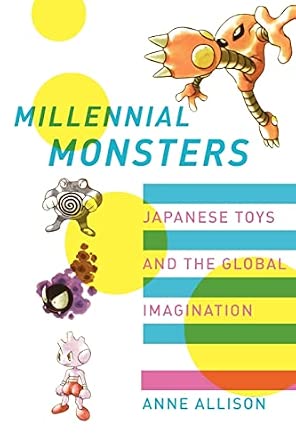
My third observation about the relationship between Japanese toys and the global imagination is that the current popularization of Japanese “cool” around the world is best understood in terms of its fantasy formation that, in turn, lends itself so productively to capitalistic marketing in the new millennium. As I argued at the start of Millennial Monsters, key here are the two qualities of polymorphous perversity (continual change and the stretching of desire across ever-new zones/bodies/products) and techno-animism (the forefronting of technology that is animated into spirits, creatures, and intimacies of various sorts). What emerges is a fantasy of perpetual transformation (humans who morph into Rangers, icons that “grow” into virtual pets) that, extended into the cyberfrontier, promises (New Age) companionship and connectedness albeit in a commodity form. Resonant with the fluctuation, fragmentation, and speedup facing postindustrial youth across the world, such a fantasy also becomes addictive, compelling players to keep changing and expanding their play frontiers through a capitalism of endless innovation, information, and acquisition. All this is certainly true of the four waves of products dealt with in this book.
None of the art/writing on this site was generated by LLMs.
If you'd like to get in touch with me, check out my about page.
Follow me with an RSS reader to be notified when I write something.