



Annotations 
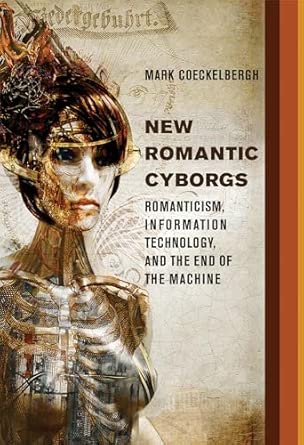
This book responds to this situation by discussing the relation between technology and romanticism in the following ways, which corresponds to the steps of its main argument: (1) it argues that current uses of electronic ICTs are not romanticism free but can instead be interpreted as realizing a surprising marriage of Enlightenment rationalism and Romanticism. This “material romanticism” had nineteenth-century precursors, but there are also new forms: cyberromanticism and especially the cyborg as a romantic figure; (2) it shows how problematic these new forms of material romanticism or technoromanticism are, given the problems related to romanticism and given that this kind of romanticism seems to turn into its opposite (what I call “the dialectic of romanticism”), and (3) it deconstructs both previous steps of the argument by showing that the new, material romanticism and the objections against it are still part of modern thinking and still belong to the romantic dialectic, and that to achieve a more profound critique of contemporary technology and culture, we need to explore different forms of thinking and different technologies—and we also need the latter (new technologies) to achieve the first (new thinking). Finally, (4) the book reflects on how difficult it is to escape from modern and Romantic thinking when dealing with technology and otherwise.
In the beginning of the nineteenth century, there was not only fear but also fascination with new science and technology (see Tresch 2012) and there were already “romantic machines” and a “mechanical romanticism.” But they miss in particular how contemporary ICTs, say, electronic devices, robots, and the Internet, have a strong romantic dimension. Even starker, these technologies seem to constitute a phase in the development of technological culture that can be interpreted as a unique and extraordinarily successful marriage of classic-rationalist and romantic modernity. Rather than representing romanticism’s antithesis, therefore, I argue that these technologies—or, more precisely, these devices and their use, not only the discourse and narratives about them, as Coyne (1999) has argued—amount to a synthesis of rationalism and romanticism. In the beginning of the industrial age, romanticism took on a “mechanical” shape (Tresch 2012). In the information age, romanticism is once again materialized, albeit in a different way. This book explores how people today, albeit unintentionally, try to realize their romantic craving for freedom, self-expression, spirituality, utopia, and authenticity by electronic means and how companies unscrupulously respond to these romantic desires with electronic gadgets that become what I call romantic technologies
Engaging with our many screens and smart gadgets and shielded from the inner, machine-like workings of our devices (developed by science), we try to satisfy our romantic desires and are more like Rousseau, Novalis, or Wordsworth than we think. We are not only romantics at heart; we are also romantics “at technology.” As in the nineteenth century, we have materialized our romanticism; only now the tools are different. This development seems to imply “the end of the machine,” signified by the celebration of the figure of the cyborg in which machine and human merge, united in love.
Yet this book is not content with analysis and interpretation; it also constructs and discusses a range of evaluations of this “cyberromanticism” or “material romanticism” when it warns for too much self-absorption and argues that much of the old criticisms of Romanticism, for example, by Irving Babbitt, are still relevant. It uses the myth of Narcissus to warn that by looking romantically into the mirror of our screens, we risk seeing only ourselves and losing sight of reality—which, as it does in the myth of Narcissus, leads to death. Moreover, the book shows that our technological hyperromanticism risks destroying its very aims when, in its obsession with authenticity and so-called social media, we become the people of “society” whom Rousseau despised: people who care only about appearances and always live in the opinion of others, needing constant confirmation from others. In other words, one can criticize these technologies and their uses from a romantic point of view: they pretend to be romantic, but in reality they are not.
By contrast, in related fields such as cultural studies, sociology, and media studies, there is a growing body of literature on romanticism and technology, which makes us aware of the history of the relation between romanticism and machines and its relevance for today’s technologies and culture. Consider, for instance, in history of science, John Tresch on The Romantic Machine (2002); in cultural studies, Walter J. Ong’s Rhetoric, Romance, and Technology (1971); in media studies and sociology, Thomas Streeter’s The Net Effect (2011); and in postmodern theory, Richard Coyne’s Technoromanticism (1999). In cultural studies and media studies, Morley (2007) also argues for more historical awareness, and Black (2002) even defends Romanticism as a framework for cultural studies. And in his literary criticism book Romantic Cyborgs (2002), Benesch has studied how the American Romantic literary discourse responded to technology, focusing on the relation between technology and authorship.
You wanted a revolution? You wanted love? Here is the technology.” As Enlightenment rationalists, we love machines. As romantics, we want life, love, humans, wonder, and mystery. Now it seems that we can have both: our machines are not caging and enslaving us but are friendly and kindly living with us and even melting with us
Never before have romantics had such powerful tools, and never before was romanticism so alive. There are plenty of possibilities for mystery and transcendence. Salvation is just a few mouse clicks away. Liberation from your body seems possible with new Platonic devices. And if you like colorful fantastic, spiritual, and demonic figures, be my guest: reenchantment is core business in the games and entertainment industry. Technology enables you to escape reality, to overlay reality by augmenting it with a romantic game, or to reach wholeness and union, perhaps reach a communion of matter and spirit. The new material romanticism as it takes shape today promises to finally realize what we may call the end of the machine.
This brings me to chapter 6, which constructs (first historical and then 1990s style) objections to these material romanticisms and to the narrative about romanticism and technology. Is their relationship and marriage an illusion? First, I draw on classic antiromantics such as Irving Babbitt to construct the argument that romanticism leads to escapism and what I call cybernarcissism: looking into the mirror of our screens, we lose sight of reality, and this can be lethal
In a remarkable reversal of moral perception and value, romantics experience civilization and society, not nature, as alienating. After Rousseau, we all look for authenticity and naturalness outside society.
Nature thus helps us to forget ourselves and reach harmony with nature. Rousseau tries to forget himself by becoming one with nature: “I never meditate, I never dream more deliciously than when I forget myself. I feel ecstasies and inexpressible raptures in blending, so to speak, into the system of beings and in making myself one with the whole of nature” (95).
Novalis argued that the modern way of thinking had “made heretics of imagination and feeling … and turned the infinite, creative music of the universe into the uniform clattering of a monstrous mill … a mill grinding itself” (Novalis 1799, 144).
In times now passed. … Rivers, trees, flowers and animals had human sense. The wine poured by a visible fullness of youth—a god in the grapes—a loving, maternal goddess, growing upwards in full, golden sheaves—love’s sacred intoxication a sweet duty to the fairest of god ladies—Life, like spring, thundered down through the centuries, an endlessly bright feast of heaven’s children and earth’s inhabitants … it was Death who interrupted. … The gods disappeared with their retinue—Nature stood alone and lifeless. An iron chain held it in arid count and strict measure. … Gone was the imploring faith, with its all-changing all-relating divine twin, imagination. A cold north wind blew unfriendly over the frozen plain, and the rigid place of wonders dissipated into the ether. Into the deeper sanctuary, into the soul’s higher realm the world’s soul drew up with its powers. (Novalis 1800, 25–27)
Novalis mixes pagan myth with Christian narrative (and he mixes prose and verse, typical for the romantic aesthetic).
Patricia Lockwood. Held.
Romantics have faith in “the transformative power of the imagination” (Safranski 2007, 131). The imagination has “magical or synthesizing power” (Novalis 1799, 135). Instead of the Philistine everyday life, the Romantics want adventurous, mysterious, extraordinary lives. This is also why they celebrate childhood, which is seen as a golden age (41).
Daoism.
Reenchantment was not only a means to make the world less boring; it was also a defense against nihilism. It was an attempt to restore value and meaning to what they perceived as a disenchanted world. Later Nietzsche asks the same question: When God is explained away, is there still meaning? The Romantics answer by bringing in God and gods and mystery. Their urge for reenchantment, combined with transcendentalism, leads Romantics to embrace “poets, madmen, saints, prophets” (Novalis 1799, 61), individual and communal madness, and magic. Interestingly, in Novalis’s romanticization, reenchantment also includes a transformation of the sciences: “magical chemistry, mechanics, and physics” (22) and “magical astronomy, grammar, philosophy, religion” (125).
the self—he even echoes the mystic’s phrase that “self equals nonself” (59)—and ascribed to the artist the social responsibility of guiding others toward magical truth. He also recommended critical contemplation. Influenced by Johann Gottlieb Fichte, his aim was to merge philosophy and poetry, rational argument and imagination; he did not reject the former. He also advised artists to not only look inward but also, in a second step, achieve “an active outward gaze—autonomous, constant observation of the external world” (27).
As Ferber puts it:
It is one of the accomplishments of the Enlightenment that most thinkers take for granted that religion, philosophy, and science are distinct domains with their own projects and procedures. … This was not the view characteristic of Romanticism. Constantly striving for unity between subject and object, feeling and knowledge, fact and value, truth and beauty, Romantics typically saw these three domains as one. … Most of them embraced the Enlightenment, but sought a new synthesis whereby faith, science, and reason … would be different faces of the same universe, and that all of them would express the cultivation, or Bildung, of the human spirit. (Ferber 2010, 89)
Novalis, for instance, was not only a poet but also a philosopher, that is, someone who, as Novalis (1799) himself wrote, “lives on problems as the human being does on food” (68). The philosophy he practiced was transcendentalist: Platonist, but also Idealist and what we would now call relativist. Novalis saw the world as “a communication—a revelation of the spirit” (81), and long before postmodern philosophers, he argued that there is no objective truth. According to Novalis and in line with the Idealist philosophies of this time, the world and the human being are a trope of the spirit (67, 105). This also means that language plays a crucial role in thinking. Long before twentieth-century thinkers, Novalis recognized that a text can have many meanings (108) and that there is a sense in which language speaks (to put it in twentieth-century terms). Taking a radical antirepresentationalist view, he writes that language “is concerned only with itself” and that languages “constitute a world of their own. They play only with themselves, express nothing but their own marvelous nature” (83)
The romantic revolution in culture was not about artistic self-indulgence. Art was life because culture was the means to directly fashion a conscious world within which one lived. The romantic subject was often represented as a poet-magician conjuring new realities through discourse. … Art was the primary means to re-enchant the world; it restored a world that was damaged by instrumental rationality to itself. (Black 2002, 27)
Thus, both religion and politics are conducted by aesthetic means, if not replaced by art. Art will save us, and it will save the world. Schiller argued that art involves all our faculties: not only intellect, but also imagination and feeling, for example. Everything can be interesting.
The epistemology developed here rejects the picture of a gap between an independent, objective reality and a separate subject. Object and subject are entangled, and knowledge is the result of active creation. According to Taylor, “What the voice of nature calls us to cannot be fully known outside and prior to our articulating/definition of it. We can only know what realizing our deep nature is when we have done it” (Taylor 1989, 376). But since there is no independent reality, this articulating is at the same time creating. Reality manifests itself, reveals itself, in the creation of new form rather than in “the reproduction of forms already there” (379). Active creation by the “I” is key, and the artist is the model human being who reimagines and reshapes the world. Everything is in the “I” and everything can change through the “I.” Fichte offered the concept of such a “dynamic, world-grounding, world creating” I (Safranski 2007, 42). The artist will create a new world. The task of the artist is no longer mimesis but creation. It is not even expression, Novalis argued. Poetry has its own voice and creates its own reality. It is artificial, intuitive, and spontaneous. At the same time, this “I” is always connected to nature. There is a “creative power that works throughout Nature,” as Herder thought (7), and indeed a creative power that works through the individual. Fichte thought that this power works in us unconsciously (45).
Romantics search for folk traditions and create a national culture.
For Marx, liberation is not about self-consciousness but is “real liberation,” which can be achieved only “in the real world and by real means” (38). Surprisingly perhaps, these means include technology, the high tech of the time: Marx writes that “slavery cannot be abolished without the steam-engine” (38).
The early Marx thus defends a kind of material romanticism that combines a romantic interest in spontaneity and life and resistance against alienation with a materialist outlook, emphasizing the material basis and even seeing technology as a tool for social change. But this materialism does not alter the focus on ending alienation, on liberation and expression, and on transforming the modern world. With Black, we can also point to Marx’s emphasis on praxis (reason alone is not sufficient for emancipation) and his love of the grotesque (Black 2002, 4). (I say more about the gothic Marx later in this chapter.) Marx shows that romanticism can be political.
Based on his reading of Hitler’s Mein Kampf, Safranski argues that it was in social Darwinism, “vulgarized science” (246), rather than in Romanticism, that National Socialism found the source for its anti-Semitic and murderous ideology. The Nazis thus (mis)used science and in fact developed “a highly technological, industrially productive, autobahn-building society” (243). If there is a romanticism in such a world, Goebbels suggested in a speech, it is a romanticism that seeks reenchantment in the results of modern technology (244). Could not the same be said of our time?
More generally, the reenchantment of Romanticism is geared toward reunification: reunification with nature, with others, with the whole. Romanticism, says Taylor (1989), aims at “bringing us back in contact with nature, healing the divisions between reason and sensibility, overcoming the divisions between people, and creating community. … We ought to recognize that we are part of a larger order of living beings, in the sense that our life springs from there and is sustained from there” (384). This aim of reunion and reunification thus at the same time concerns “nature,” “community,” and a “religion.” It also refers to the original meaning of religion, which is about re-ligare: the aim is to connect again, link again, reunite. Indeed, the idea is to link up with something greater than yourself: community, society, the world, being, God, and so on (see also Taylor 1989, 427).
Nietzsche says in Human, All Too Human (1878) about the artist that his art aims at inspiring “unrest” and “disorder”; it is not about truth but about everything a true Romantic desires:
[The artist] does not want to give up the most effective presuppositions for his art, that is the fantastic, the mythic, uncertain, extreme, belief in something miraculous about genius: thus he thinks the continuation of this manner of creating is more important than a scientific dedication to truth. (Nietzsche 1878, 103–104)
Given this focus on creation rather than (scientific) truth, the artist “does not stand in the front ranks of the enlightenment” but remains a “child or youth,” and his task is “the juvenescence of mankind” (104); he reenchants the world with his artistic effects.
Nietzsche explains that the Enlightenment has forced feeling out of the religious, but feeling did not disappear: it “throws itself into art”: “The wealth of religious feeling, swollen to a river, breaks out again and again, and seeks to conquer new realms” (105).
Romanticism leads to New Age Mysticism
Where there are no gods, ghosts reign. (Novalis 1799, 148)
In A Philosophical Enquiry into the Origin of Our Ideas of the Sublime and Beautiful (1757), Edmund Burke had argued, against Plato, Aristotle, and the classicism of his time, that the aesthetic should not be reduced to what is pleasing. In classic thinking, aesthetics is about beauty defined in terms of proportionality, regularity, and perfection, which are pleasing to the eye. But Burke—closer perhaps to ancient tragedy than to ancient philosophy—added the category of the sublime, which is not immediately pleasing but quite the opposite: it invites fear, pain, awe, and horror, although there is then pleasure in knowing that one is at a safe distance or that it is not real. Burke writes: “The passion caused by the great and sublime in nature … is Astonishment, and astonishment is that state of the soul, in which all its motions are suspended, with some degree of horror” (101). He also mentions terror: “Indeed terror is in all cases whatsoever … the ruling principle of the sublime” (102).
In sixteenth-century England, Protestantism had wiped out a substantial part of Roman Catholic culture and ritual with the dissolution and pillage of monasteries, the execution of religious leaders, the rejection of the “superstitious” worship of saints and relics, and effectively a dismantling of “the whole calendar of customs and lore—the fabric of everyday life” of the earlier period (34). The result was that by the eighteenth and nineteenth centuries, if not much earlier, many people in England were nostalgic about the lost medieval, Catholic past. More generally, artists started to explore and reconstruct their ancient past in search of the wonder and the mystery that had been wiped out by Protestant and rationalist (quasi-) secularization. Combined with an interest in the more carnal, material, and violent aspects of human history and culture, including “sex, rape, torture, dismemberment, decapitation, death” (36), this resulted in what is usually called “Gothic.”
There was an interest in ruins, which reminded people of the medieval past (some “ruins” were actually newly built); more natural, “wild,” chaotic Romantic English gardens were created; and Gothic literature emerged in which haunted castles were filled with everything the Gothic imagination could dream up: ghosts, crypts, graves, animated corpses, hidden skeletons, secret passages and labyrinths, Catholic ritual, nightmares, demons, devils, witches, inexplicable whispers and groans, murder, sex, rape, vampires, and all else that was seen as dark, forbidden, supernatural, and “superstitious.”
Dungeons and dragons comes out of the resurgence of Gothic lit in the first half of the 20th century
In The Stones of Venice (1853), John Ruskin sees imperfection as a key feature of a Gothic building: the buildings are “expressive of the artisans and builders who made them” (Groom 2012, 108).
For Romantics and Goths, the night is a time when the creative imagination is released, an imagination that may lead us to truths that perhaps cannot be accessed in daytime, truths that need the distortion of dream to reveal themselves to us. Next to Enlightenment self-government, the absence of self-government is seen as a gateway to higher truths. Art needs dream, madness,5 and inspiration.
it is true that Mary Shelley was critical of science; her novel is usually read as a warning against science and technology. It is hubris against the gods. But her message was far more subtle and nuanced than many contemporary readers think: she was writing not so much against science and technology as such, but against a science and technology that became abstracted from life, family, and society; against a science unconcerned with its consequences.
As Hindle writes in his introduction, the novel is about “the dangers of putting the ‘abstracted’ pursuit of knowledge before collective responsibility and happiness … science and abstraction will soon become cold, unless they derive new attractions from ideas of society” (xxix). To put it in the language of duty ethics: science has duties and scientists have duties: duties toward society and toward the technologies they create. As the monster says in the novel, “Do your duty toward me, and I will do mine toward you and the rest of mankind” (Shelley 1818, 96)
Later, Gothic artists will also happily use the new media and technologies of their time, such as the cinema. Groom writes, “Rapidly innovated special effects and camera techniques made the moving image a stunning new tool in representing not only fantastic visions, but also in making the familiar mysterious” (Groom 2012, 122). These are, of course, very Romantic aims.
The horror film was born, influenced by Gothic. And Freud is always present. Room is made for sex, violence, exorcism, witchcraft, and so on. In countries with a culture rooted in Protestantism such as the United States, there is a high demand for what is normally repressed. There is also science fiction with Gothic elements such as Alien. William Gibson’s novel Neuromancer and cyberpunk6 are influenced by Gothic. And film has enabled billions of people to consume reconstructions of the past. Gothic horror and Romantic medievalism also influenced and continue to influence computer games, and Goth culture is present in contemporary digital culture more generally; consider, for example, interest in cyborgs and steam punk. (In chapter 4, I say more about twentieth-century science fiction and cyberpunk.)
Quake. Doom. DnD. Warhammer 40k
Marx and Marxian thought is usually interpreted as representing Enlightenment thinking. Yet there are certainly Romantic elements in Marx—for instance, in his analysis of alienation in his Economic and Philosophic Manuscript of 1844 in which he regrets the loss of self-realization, spontaneity, and (inner) life. But there are also Gothic elements. First, as Jacques Derrida has alluded to with the title of his book Specters of Marx (1993) and his “hautology,” the ghostly and the spectral are certainly present in Marxian thought and especially in The Communist Manifesto (1848), which famously begins with the phrase, “A spectre is haunting Europe” (2). Marx clearly uses a very Gothic metaphor here. But, interestingly, Gothic is also present in Capital, in particular the figure of the vampire. For instance, in volume 1 of Capital (1867), Marx writes, “Capital is dead labor which, vampire-like, lives only by sucking living labor, and lives the more, the more labor it sucks” (342). And there are more references to the vampire metaphor in Marx. It makes sense to interpret him as outlining what Neocleous calls a “political economy of the dead” (2003). Marx sets up a distinction between living labor and dead labor. Capital, with its desire for accumulation, sucks life out of the workers. It sucks up living labor. Like a vampire, it lives (is undead) only “thanks to the sensuousness of the living” (Neocleous 2003, 683). Instead, Marx suggests in a Romantic fashion that we should live spontaneous and creative lives, and we should choose life rather than the vampire of capitalism. The myth he suggests is very Romantic: first there is the paradise of undisturbed living labor; then there is a Fall when capital rises among the living and sucks the living labor. Amedeo Policante (2011) summarizes what we could call the Fall of labor: “At the beginning it is creativity, living labor. At the beginning, it is the free play of human beings transforming the life-world of nature through the productive power of their minds and bodies. … At the end, it is capital” (abstract). In other words, Marx’s socialism is more Gothic-Romantic than one may expect; it fuels his early Romantic analysis of alienation but also his political economy in Capital.
David McNally further connects Marx’s monster metaphors to tales of the grotesque in folklore, literature, and popular culture. In his book Monsters of the Market (2011)
McNally writes, “Commodities thus inhabit a world of ‘magic and necromancy’ in which sensuous things (use-values) are mysteriously transformed into entities of an altogether different order (values), as if by alchemy. Through these reversals, material goods metamorphose into bearers of something ghostly” (126). How more gothic can socialism get?
Many Romantics were politically active and took part in political action or explored alternative forms of society and community, inspired, for instance, by medieval or ancient Greek culture. Moreover, that political aspect did not necessarily have a conservative nature (let alone that it always and necessarily prefigured Nazism). Although in the first half of the nineteenth century many Romantics turned conservative and many were nationalists—indeed even, like Herder, helped to invent it—–the early Romantics were very sympathetic to the French Revolution, if only because revolution means sudden change, an epochal event in our lifetime we can be part of.
While German romanticism became unmistakably conservative in the early nineteenth century, this does not justify ignoring the extraordinary vision of radical democracy evident in the early texts. … The early romantics were anything but racist. They believed deeply in cultural authenticity: they extended tolerance and pluralism to all cultures, and are regarded as a major source of contemporary multiculturalism. (Black 2002, 32)
It is this side of romanticism that enables Black to argue for “a romantic, critical imagination built upon a solidarity that projects outward from deep, textured, and extensive relationships with real people, not distance and category,” which he thinks is “the only means by which the articulation of local and global might effectively be imagined” (144). This democratic and open aspect of romanticism, however, is based not on abstract reason but rather on empathy and is rooted in people and places; the global is connected to the local.
Romanticism is not necessarily “oblivious to production, structure, and social responsibility” (Black 2002, 153). On the one hand, it is true that an economy of abundance and the consumer culture made possible that—at least for some people—“pleasure was increasingly projected onto imaginary experiences, images, and dreams” (154), and this is all the more the case today. (
In response to the industrial revolution with its mass production and the beginnings of consumerist culture, the arts and crafts movement proposed a return to traditional craftsmanship and skills. Its aesthetic was also romantic in its medievalism and interest in folk art. Flourishing at the end of the nineteenth century, it was heavily influenced by Ruskin, who had his views on aesthetics but also voiced social criticism; he had already argued against the industrial revolution with its mechanized production and instead proposed independent workers who designed their own things. He introduced what he called “arts and crafts.” For Ruskin, free creation in the form of working with your hands gives pleasure and happiness; mechanization is not good for the soul. He praised “the perfect workmanship of the Renaissance” (Ruskin 1853, 13) and argued that “all great art is the work of the whole living creatures, body and soul” (181). But according to his followers, the problem was not so much the machine itself but rather the factory system of production and the related specialization of labor, which robs workers of their independence and leads to a loss of skill.
As Clive Wilmer puts it, “Morris’s desire to improve design was inseparable from his desire to improve society” (Wilmer in Morris 1890, xxviii). Although Morris was not altogether opposed to machines as such (see also below), he saw what mechanization did to workers and to society. He wanted to bring back the independence of the worker and the beauty that had been lost on the road to industrial progress. For this purpose, he created things but also engaged in politics. He founded the Socialist League and advocated the socialist world revolution. He knew Engels and was a friend of the anarchist Peter Kropotkin. He wanted a classless society, and in this sense he was a Marxist. Like Marx, he was leading a bourgeois kind of life and—contrary to his longing for the countryside and like many contemporary eco-romantics—he lived in an urban environment: his main home was in London, not rural Oxfordshire. However, unlike Marx, Morris engaged himself in material production and proposed an alternative production method instead of predicting and hoping that industrial society under capitalism would transform itself into something else. And in contrast to Marx, he sympathized more with religion: religion in the form of Christianity (in his early days he even considered becoming a priest) but also the paganism and the values and virtues that he found in Iceland (personal courage, craftsmanship, the unimportance of social distinction or wealth, health, and closeness to nature—see again Wilmer in Morris 1890, xxxi). He was also romantic in his belief that human society develops in a natural, organic way.
In 1890 Morris published his utopian novel, News from Nowhere, which uses the utopian dual movement of backward looking/forward looking to develop a vision of an alternative society. His romantic socialism (or socialist romanticism) becomes very clear in the novel. Morris dreams of a world before the Fall of industrial revolution.
As Carol Silver (1982) has argued, Morris combines Marxism and romance: he is an enchanted wanderer who embarks on a quest for love, fellowship, and a new self. At the same time, the book is a social vision. Morris’s imagination is romantic, but with a strong social side to it. His romanticism and medievalism is not merely escapist; it fuels thinking about how to change his society. At the end of the novel, Morris asks us “to build up little by little the new day of fellowship, and rest, and happiness” (228).
In general Morris was far more positive about machines than one may suppose. He thought that machines could release us from the mechanical part of labor. In News from Nowhere (1890) he is even lyrical about their wonders: “It may be fairly said that the great achievement of the nineteenth century was the making of machines which were wonders of invention, skill, and patience” (126). Here the wonder of romanticism meets the machine (see also the next chapters). But the problem, in Morris’s view, is that machines are used for “the production of measureless quantities of worthless makeshifts” (126). This is unacceptable to Morris the romantic and Morris the craftsman, who are disappointed with the ugliness and the low quality and lack of craftsmanship of the products of the industrial world. But as he clarifies in his lecture “How We Live and How We Might Live” (1884), this “amazing machinery” has also significant negative social consequences: it has become our monstrous master.
Morris argues that we should not be the slaves of machines and that they should not “injure” the beauty of life—the beauty of products but also the beauty of the people and of the collective life:
I have spoken of machinery being used freely for releasing people from the more mechanical and repulsive part of necessary labour; and I know that to some cultivated people, people of the artistic turn of mind, machinery is particularly distasteful, and they will be apt to say you will never get your surroundings pleasant so long as you are surrounded by machinery. I don’t quite admit that; it is the allowing machines to be our masters and not our servants that so injures the beauty of life nowadays. (Morris 1884, n.p.)
Thus, according to Morris, the problem is not machines as such but that we use machines to enslave people. Machines themselves are not the main problem; ownership and social relations are (see also the Luddites later in chapter 4). And if machines themselves are a problem at all, Morris thought, it is because they do not enable us to experience pleasure in work. But this does not lead Morris to reject machines altogether. Instead of proposing to ban machinery, he offers a different social-technological vision: he predicts that at first, there would be “a great development of machinery for really useful purposes,” but when people realize that some things can be done more pleasantly by “using hand-work rather than machinery,” they will “get rid of their machinery” and cease to be “slaves to the monsters which we have created.” In other words, “the elaboration of machinery … will lead to the simplification of life, and so once more to the limitation of machinery” (n.p.). Thus, for Morris, there is no need to fight against the machines, no need to try to destroy them; instead he thinks people will move to handwork because of its intrinsic pleasure and worth.
Becky Chambers. Psalm for the Wild Built.
The opposition to mechanical existence and the claim that machines should not be our masters will be shared by many philosophers of technology in the nineteenth and twentieth centuries (see the next chapter). Morris’s “people of the artistic turn of mind”—say, romantic artists—who care about making beautiful things are of course also to be found in later times, and the idea that machines should not bereave us from beauty will also be echoed in later art and in contemporary times, even in places where one might not expect it
Postmodern currents of thought share not only the romantic rejection of a one-sided emphasis on reason (as Black shows, postmodernism “has again pressed the familiar charges against reason”; 2002, 2); they also share the Romantic epistemology and many romantic-gothic themes, including ghosts. Authors such as Derrida, Jean-François Lyotard, Jacques Lacan, and maybe Michel Foucault preserve the mysterious, the unknown (e.g., in Lacan, “the real”) against the Enlightenment claim that everything is knowable, at least in principle. Through Nietzsche, Freud, and perhaps Heidegger, they inherited a deep suspicion of Enlightenment reason, a nonrepresentationalist epistemology, the view that language actively mediates and constructs reality, an interest in chaos, and a “dark” view of the self that we can never fully know. These authors could use romanticism in this way since, in the words of Black (2002), romanticism is more than an “assortment of poems, essays, and manifestos which, like so many pressed flowers, are beautiful and dead”; instead it is “a vital philosophical tradition” (5) that still influences our vocabulary today, for example, in so-called continental philosophy, literary criticism, and cultural studies. And via Kant, many philosophers have also inherited the idea that objective knowledge of reality is not possible, that there is a noumenal realm that we cannot know—even as the romantics rejected Kant’s “Cartesian separation of consciousness and reality” (23). Romanticism can also be interpreted as a precursor of hermeneutics. This is how Black summarizes what I have called Romantic epistemology: “Knowledge consists in the disclosure or revelation of what was, prior to utterance, not yet said, the defamiliarization of a hitherto unknown or ineffable reality” (4). Black contrasts this with ideology critique, which “allows little surprise or discovery in its epistemology,” and with poststructuralism, which “writes off the unrepresented as a permanent unknown excluded from the sealed envelope of discourse, a discourse authorized by the relentless machinations of power/knowledge.” According to Black, such ideas contribute to more rather than less disenchantment (67).
This brings us to differences between Romanticism and postmodernism/poststructuralism. The idea that we can know only a linguistic or a simulated reality, for instance, can be seen as a radicalization, if not a caricature or perversion, of Romantic idealism. As Black explains, Romantics thought that language mediates and constructs reality, but at the same time, they believed that we are always embedded and involved in the world. Romanticism was not yet “divorced from the real” (31). Romantics rejected a firm foundation of the truth, but this should not be confused with postmodernism’s rejection of truth in any form (34). It acknowledges the chaos and indeterminacy of reality but retains “confidence that meaningful things might be said of it” (66). Black writes about nihilism: “Nihilism, of course, always threatens. But the romantic solution is to keep meaning moving through space, to write as if one’s very life depended on it—as it does” (143). Therefore, Black argues, for instance, that Lyotard’s rejection of metanarratives would be unacceptable to Romantics. Romantics would not have a problem with fiction, of course, but their view was that instead of rejecting narratives of denying the possibility of knowledge, we should “forever rewrite these stories … develop a better mythology” (29). According to Black, Romanticism’s epistemology and ontology is relational: it “supports a continuous process of reinvention through contextual redefinition” (68).8 Whether we endorse Black’s defense of romanticism, it is clear that these contemporary philosophical movements have deep and complex relationships to romanticism as a philosophical tradition, which are not merely historically interesting but relevant today.
Romanticism also influenced various twentieth-century art movements such as expressionism, surrealism, and Dada. For instance, the Der Blaue Reiter group of artists at the beginning of the twentieth century believed in art as a way to express spiritual truth and the importance of spontaneity and intuition; they were also interested in medieval art and primitivism. And in the 1920s, surrealists such as André Breton wanted to bring together dream and reality in letting the unconscious express itself. Against bourgeois values, they embraced the irrational. Breton’s First Surrealist Manifesto (published in 1924) stressed the importance of letting thought express itself “in the absence of any control exercised by reason.” He argues that boundaries set by reason and logic create “a cage from which release is becoming increasingly difficult”; instead, he proposes to explore the human mind and its “depths,” which “conceal strange forces,” which we should try to capture (n.p.). Referring to Freud, he turns to dreams and welcomes their absurdity, their strangeness, and their spell. And the surrealists wanted revolution: social revolution (they had sympathies with communism and anarchism) and—very romantically—a revolution that breaks down the division between art and life (see also Taylor 1989, 471).
Indeed, these romantic art movements remind us of the early nineteenth-century Romantics and, of course, later artists who thought that art is life and that everyone is an artist. Barriers between art and life need to be broken down. For example, Joseph Beuys said that art should not be “confined to the restrained boundaries of the Art world: but rather has to open itself to ‘live processes.’”9
Hippies experimented with new lifestyles, including new clothes, drugs, music (rock ’n’ roll), and sexual relations. Much of this was made possible by technology. For instance, electric guitars made possible new kinds of music, and a new contraceptive, the pill, created more room for sex before and outside marriage. Propelled by movies, radio, and television, the counterculture spread through the Western world. It happened in San Francisco, New York, and London, but also in Paris, Amsterdam, Rome, and Berlin. Sometimes the goal was revolution (here, the movement merged with the so-called New Left), sometimes communes were set up, or both. There was protest against the Vietnam War and against authorities and violence. There was a belief in the power of art (e.g., music) and imagination. There was an interest in transcendence, expanding consciousness (often with the help of psychedelic drugs such as marijuana and LSD), and Eastern religion and practices (e.g., Buddhism, yoga). The goal was social, cultural, sexual, and spiritual liberation. More generally, there was a growing interest in religion, spirituality, and the occult, but as in early Romanticism, organized religion was rejected in favor of personal spiritual experience. Hippies explored alternative religions such as neopaganism and alternative ways to organize religion, such as communes.10
New Age.
afranski writes about “the demand for the historical moment”: “Every generation would like to have an experience of epochal upheaval. The 68ers believed their moment had come. The dynamic of the movement changed those who took part in it. They could feel themselves as new subjects” (2007, 267).
It is not difficult to recognize many key romantic features in this movement—and indeed in later outgrowths of it, such as New Age and environmentalism: the rejection of the philistine mainstream (nonconformism), the use of art (now mainly music) to achieve personal liberation and societal transformation, the interest in historical events and the connection between personal and political liberation, a return to nature and more traditional ways of living (as many communes attempted), political engagement and interest in revolution and radical change, experimentation with alternative ways of living, and an interest in nonmainstream, nontraditional forms of religion and spirituality, which link the individual to the larger whole. The
The hippie was a neoromantic figure pur sang. The May ’68 slogan, “Power to the Imagination!” (267) is telling: it is hard to think of a more romantic phrase. It seems that the countercultural movement was proof of the vitality of the romantic tradition and gave it new impetus.
Safranski, for instance, interprets the fact that “people used popular music to celebrate their Dionysian Saturnalia” as escapism (268). In any case, here we have another parallel with nineteenth-century romanticism: an interest in the Dionysian. Rationality is supplemented by, and sometimes replaced with, feeling. There is room for ecstasy, madness, the irrational.
the Internet is hospitable to all the dreams and nightmares of the romantics. It seems to provide opportunities for escapism (e.g., by means of gaming) but also for new global and local communities. Furthermore, in art, romanticism has since long become the mainstream: the focus is more than ever before on the autonomous artist, on the imagination, and especially on the person and individual genius of the artist. Our attitudes toward the environment are still very romantic: it is part of our “vulgar Rousseauism” that we want to be close to nature, return to nature, be authentic, be natural (see also Coeckelbergh 2015a). And there are still many romantic responses to technology: rejection and fear of contemporary technology (sometimes combined with a longing for a romanticized past) but also fascination. Consider, for instance, the fear of, and fascination with, robots, which are seen as either taking over the world or as friendly and sexy companions.
In The Romantic Ethic and the Spirit of Modern Consumerism (1987) sociologist Colin Campbell has argued that Romanticism has even facilitated the rise of modern consumerism. To show this, he starts with identifying a form of modern, self-illusory hedonism that focuses on emotion (something “inner”) rather than sensory experiences (related to the outside world) and presents individuals with the possibility of controlling their experience and pleasure. This happens through the imagination: the modern hedonist is a “dream artist” (78) who creates and enjoys daydreams. Modern consumption, according to Campbell, is not about the actual use of products but about “imaginative pleasure-seeking to which the product image lends itself” (89). The product does not so much give but promise modern hedonists new experiences that they have not yet encountered in reality. The “new” product affords dream pleasure. The product is “material for illusory enjoyment” (92).
Romanticism provided that philosophy of “recreation” necessary for a dynamic consumerism: a philosophy which legitimates the search for pleasure as good in itself and not merely of value because it restores the individual to an optimum efficiency. … At the same time, Romanticism has ensured the widespread basic taste for novelty, together with the supply of “original” products, necessary for the modern fashion pattern to operate. … In all these ways, Romanticism has served to provide ethical support for that restless and continuous pattern of consumption which so distinguishes the behaviour of modern man. (Campbell 1987, 201)
Romanticism and technology are usually assumed to be incompatible. Romanticism is associated with feeling, imagination, and nostalgia. It is seen as backward looking and conservative. It is also seen as religious. It is supposed to be dreamy and otherworldly. It is about subjects, spirits, and ghosts. It is about magic. Technology, by contrast, is associated with objectivity, rationality, and an orientation toward the future. It is seen as nonreligious or even antireligious. It is seen as practical and realistic, quite the opposite of dreamy. It is concerned with this world—if the concept of another world is taken to make sense at all. Technology is about objects, materiality, and machines.
Interestingly, this assumption is found not only among those who warn against the dangers of modern technology but also among those who embrace contemporary technology and seek to change the world by means of new technology.
Classic thinking about technology tends to be very critical of, if not opposed to, modern technology and society. In the German philosophical tradition, this criticism is directly rooted in romanticism. Today we inherit the opposition between science/technology/disenchantment and romanticism/religion/enchantment from Max Weber, who in turn borrowed it from the Romantic philosopher Schiller—or so it has been suggested by Jaspers and many other authors after him. It is plausible that, as Angus (1983) has argued, Weber appropriated Schiller’s contrast between the unity of ancient Greek life and modern fragmentation, a problem that Romantic art and aesthetics sought to overcome.
In “Science as a Vocation” (1919), Weber does not argue that science and religion are necessarily opposed. On the contrary, he attends the reader to the fact that Protestant and Puritan scientists wanted “to show the path to God” and that in early modern times, one hoped “to come upon the traces of what He planned for the world.” But then he argues that “today,” in modern times, no one believes this. We no longer see meaning in the universe. Today science is no longer seen as a way to God but is “irreligious” (142). He contrasts this science with the craving for religious experience and the interest in “the spheres of the irrational,” which he calls “romantic irrationalism” (143). He also contrasts serious science with “the naïve optimism in which science—that is, the technique of mastering life which rests upon science—has been celebrated as the way to happiness” (143). Thus, on the one hand, there is rational science; on the other hand, there is religious-romantic craving and naive optimism: all kinds of beliefs that he thinks have no place in rational science. Science, according to Weber, cannot give an answer to our questions about the meaning of life and our questions about what we shall do and how we shall live.
technologies are never mere means but also shape our ends.
In The Protestant Ethic and the Spirit of Capitalism (1905), Weber speaks of what is often translated as an iron cage—or, more accurately, housing, shell, or perhaps a heavy and fixed exoskeleton (the metaphor is supposed to contrast with cloak, which is “light” and removable). And here we meet technology: human beings become cogs in the machine. Weber writes that the modern economic order
is now bound to the technical and economic conditions of machine production which to-day determines the lives of all the individuals who are born into this mechanism. … Perhaps it will so determine until the last ton of fossilized coal is burned. In Baxter’s view the care for external goods should only lie on the shoulders of the “saint like a light cloak, which can be thrown aside at any moment.” But fate decreed that the cloak should become an iron cage. (Weber 1905, 123)
Romanticism, then, appears here as the opposite of disenchantment, the opposite of asceticism, the opposite of the machine, and the opposite of the religions that have secularized the Western world, have taken away possibilities for spontaneous enjoyment, and have contributed to our becoming cogs in the machine. Technology, in the form of the machine, is part of a capitalism that has caged us in our everyday lives and has delivered us to impersonal bureaucracy and mechanical industrial production.
For Benjamin, the camera(man) penetrates deeply into reality with his “mechanical equipment” (227). There is no longer distance and time for contemplation. Film changes the image all the time. Thoughts are replaced by movie images since there is constant change (231). Quality is replaced by quantity. Concentration is replaced by distraction (232–233). The public is “absent-minded” (234).
An exception is Carl Mitcham, who in his epilogue to his seminal work Thinking through Technology (1994), recognizes and takes seriously romanticism as one way of “being-with technology” (289–299). He takes it seriously since he sees Romanticism not only as a reaction to and criticism of modern scientific rationality, a view of nature as “one of process and change” (295), and a defense of the imagination in order to overcome the limitations of reason (this is nothing new). He also sees it as a questioning of technology, even the first questioning of modern technology:
What is seldom appreciated is the extent to which romanticism can also be interpreted as a questioning—in fact, the first self-conscious questioning—of modern technology. (Mitcham 1994, 290)
Earlier in the book, he also mentions Rousseau’s Discourse on the Science and Arts (see chapter 2), Ralph Waldo Emerson, and other romantic responses to technology. He also refers to Heidegger’s idea that modern science and technology “does not know itself”; it does not know its own limits (54). Mitcham thus not only assigns an important place to Romanticism in the history of philosophy of technology; he also explicitly recognizes some of the ambiguity of romanticism’s relation to technology; this is rather exceptional in contemporary philosophy of technology, which usually assumes a one-sided view of the matter.
heirs of the Enlightenment: they believe in clarity as opposed to romantic darkness and shadows, rationality as opposed to emotion, analysis as opposed to narrative, evidence as opposed to intuition, down to earth and practical rather than dreamy, contributing to making things work versus being on the sideline, dealing with stakeholders, power, interests, political economy versus utopian thinking, and so on.
even if contemporary philosophy of technology may, explicitly or not, understand itself as antiromantic, it nevertheless contains quasi-romantic elements. Consider, for instance, its sympathies to the idea that designing and using artifacts can and should be used to shape one’s subjectivity and one’s life (this might be presupposing the romantic idea that living is an art and that we should all become artists) and that design (art) can and should change society—an idea inherited from twentieth-century countercultural romanticism, now often mixed with consumerism. I will return to more contemporary technology in the next chapters when I discuss links between information and communication technologies and romanticism. But I first further explore the ambiguous relation between romanticism and technology in an American context by commenting on Leo Marx’s The Machine in the Garden (1964).
Thoreau’s Walden (1854, a classic romantic book), which disrupts nature (15).
The locomotive, associated with fire, smoke, speed, iron, and noise, is the leading symbol of the new industrial power. It appears in the woods, suddenly shattering the harmony of the green hollow. … The noise of the train … is a cause of alienation in the root sense of the word: it makes inaudible the pleasing sounds to which he [Thoreau] had been attending, and so it estranges him: from the immediate source of meaning and value. … In truth, the “little event” is a miniature of a great—in many ways the greatest—even in our history. (Marx 1964, 27)
Walden may easily be taken to be an antitechnology book: “men have become the tools of their tools.” But Marx shows that Thoreau’s position was more complex: instead of expressing “simple-minded Luddite hostility toward the new inventions” (247), Thoreau attacked the idea that society should be ordered according to a machine and that people become machines: “The laboring man becomes a machine in the sense that his life becomes more closely geared to an impersonal and seemingly autonomous system” (248). The locomotive in Walden is sometimes a “hawk” but also a “partridge,” blending into the landscape (251–252). It is very different from the pond, of course, but Thoreau is also “elated by the presence of this wonderful invention” (252). There is hope and promise. His
Thomas Carlyle, who argued that “men are grown mechanical in head and in heart, as well as in hand,” did not deny the advantages of machine production and did not want to return to an earlier society (174), but rather defended a return to a “balance” in the human situation instead of the determination of human behavior by external, invisible, abstract forces alien to human impulses (176).
Marx also discusses Melville’s Moby-Dick; or, The Whale (1851), a classic in American Romanticism. The novel further supports my point that the romantic relation to technology is more ambiguous than usually assumed.
Cunningham and Jardine point to The Novices of Sais (1802) to support this point, in which Novalis indeed writes, “Various are the roads of man,” although he also suggests an opposition between science and art: “Under [the] hands [of scientists] friendly nature died, leaving behind only dead, quivering remnants, while the poet inspired her like a heady wine till she uttered the blithest, most godlike fancies, till, lifted out of her everyday life, she soared to heaven, danced and prophesied, bade everyone welcome, and squandered her treasures with a happy heart” (25). Poetry remains the high road. But science is at least one of the roads.
the nineteenth-century Luddites were not against technology as such but rather against automation and its social consequences.
John Tresch has argued that in post-Napoleonic France, there was what he calls “mechanical romanticism.” To understand what this is, we have to begin with an insight that is entirely in line with what many philosophers of technology think: “The kinds of machines we use are bound up with the ways we think about nature and the ways we know it” (xi). Indeed, as Heidegger also argued, technologies are not mere instruments; they also shape our way of thinking. And this includes our thinking about nature.
Similarly, Alexander von Humboldt, situated “in the midst of the tempest that was German romanticism” (63), suggested that science required a mix of humans and instruments. In von Humboldt’s view, tools not only became extensions of human faculties (81); they also merged with the human: “tool and human became a single unit: the instrument was humanized, and the human incorporated the machine” (80).
Romanticism’s ambiguous attitudes toward social transformation are also still relevant to understanding technology, as is the social history of the nineteenth century in general. For instance, the infamous Luddites were not against technology as such. When in early nineteenth-century England they protested against spinning frames and other textile machines, they protested the replacement of highly skilled laborers (like themselves) with less skilled, low-wage laborers. It was mainly a social movement that acted against automation technology not because they were against machines as such, but because they opposed their social consequences, in particular lower wages and the threat to employment. But they also opposed the production of inferior goods, which threatened the reputation of their trades (Binfield 2008). The employment issue, for instance, is still relevant today, as automation threatens to replace even jobs that were previously thought to be the exclusive domain of humans. And are the big cities of today’s world not also places where romanticism and technology can be found in a cautious embrace?
It may be that as Weizenbaum argued in his 1966 article on the computer program ELIZA, the magic of machines “crumbles away” once you explain its inner workings, once it is “unmasked” (36). But first there are magic and romance. First there are machines that “behave in wondrous ways, often sufficient to dazzle even the most experienced observer” (36).
In One-Dimensional Man ([1964] 2007), one of the most famous books of the 1960s, he criticized technological rationality: by transforming nature, we become dependent on an objective order of things. This has consequences not only for nature; it also shapes society as “scientific-technological rationality and manipulation are welded together into new forms of social control” (149). Through the quantification of nature, science was separated from ethics, logos from eros. Social reality is rationalized and quantified, made calculable. There is “submission to the technical apparatus which enlarges the comforts of life and increases the productivity of labor” (162). Technology thus leads to domination and makes possible a “rationally totalitarian society” (162). The “logos of technics” leads to “the instrumentalization of man” (163):
Only in the medium of technology, man and nature become fungible objects of organization. The universal effectiveness and productivity of the apparatus under which they are subsumed veil the particular interests that organize the apparatus. In other words, technology has become the great vehicle of reification—reification in its most mature and effective form. The social position of the individual and his relation to others appear not only to be determined by objective qualities and laws, but these qualities and laws seem to lose their mysterious and uncontrollable character; they appear as calculable manifestations of (scientific) rationality. The world tends to become the stuff of total administration, which absorbs even the administrators. (172)
Sensing the folly of these plans to use computers to control human complexity, and to frame it in a predictable grid, increasing numbers of individuals began to interpret the act of computing as a form of expression, exploration, or art, to see themselves as artists, rebel, or both, and to find communities with similar experiences that would reinforce that interpretation. People need to express themselves, it was said, people want and need spontaneity, creativity, or dragon-slaying heroism. … This is why we need small computers … personal computers. (Streeter 2011, 2)
Computing thus became a romantic tool rather than its opposite. Computers were no longer number crunching “mathematical tools” (Streeter 2011, 29) instruments for calculation. They became part of a new romanticism that reimagined them as involving and supporting imagination and creativity. There was a process of “radical reclassification of computers, taking them out of the old box of mathematical impersonality and putting them in a new one that associates them precisely with individual uniqueness, distinctiveness, unpredictability, and expression—with all those things we have long associated with the romantic persona” (63). Computers became part of a romantic counterculture and helped to constitute it: “key romantic tropes—the strategic use of colloquial language, a studied informality, appeals to self-transformation instead of need-satisfaction, tales of sensitive rebel heroes, and a full-throated departure from instrumental rationality—became associated with alternative uses of computing” (14). Computers were now used to rebel against “a dangerous dehumanizing dream of centralized military control of people and complexity via computerized control systems” (19). They also seemed far removed from the machinery of the industrial age: instead of monstrous machines, microcomputers “produced no roar or smoke” but rather produced wonder (88).
In Understanding Media (1964), long before the Internet, McLuhan already explored the idea of a shared electronic consciousness:
Today, after more than a century of electric technology, we have extended our central nervous system itself in a global embrace, abolishing both space and time as far as our planet is concerned. Rapidly, we approach the final phase of the extensions of man—the technological simulation of consciousness, when the creative process of knowing will be collectively and corporately extended to the whole of human society. (McLuhan 1964, 4)
Black (2002) writes, “Information-based capitalism … murders sublime uncertainty in declaring everything knowable, a mere matter of accumulating the data and running the spreadsheets” (162). He recommends the sublime as an antidote to such “closure”:
The sublime tips the balance in favour of culture versus information by declaring some things unknowable, adding culture’s rich combination of fact and fiction to the experiential mix, and thus vastly contributing to the world’s enchantment again. Once the strategic value of the Kantian sublime, with its romantic pedigree and social nature, is admitted into the analysis, a different model of social totality is involved. This is a model of a romantic totality as radically open as the prevailing market model is closed, where the sublime represents the impossibility of its closure. (Black 2002, 162)
We come to see ourselves differently as we catch sight of our images in the mirror of the machine. … A rapidly expanding system of networks, collectively known as the Internet, links millions of people in new spaces that are changing the way we think, the nature of our sexuality, the form of our communities, our very identities. … Most recently, the computer has become even more than tool and mirror. We are able to step through the looking glass. We are learning to live in virtual worlds. (Turkle 1996, 9)
In the 1990s, computers became very much part of the human world, including the world of language. Today we take them for granted; Turkle even observes a certain “nonchalance” (3). And there are losses. Rather romantically (in her sense of the word), Turkle regrets that “the socially shared activity of computer programming and hardware tinkering has been displaced by playing games” (7); the pleasure of trying to understand computers is gone.
These 1990s developments already imply what we could call the end of the machine, or at least its invisibility. It may well be that beneath or behind the magic worlds and emotional experiences, there is still a machine, there is still (instrumental) Enlightenment reason, there is still the mechanics, and so on. But in computer and Internet use, these technical materialities (and the reasoning and tinkering of the computer programmer) withdraw from view. The focus is on the new magic worlds, the new wonderlands. The experience is magic and evocative. We have love and horror, sex and monsters. Computer experience becomes emotional and human. Computers start talking. The Internet itself, or rather the Web, is no longer seen as a technical object or infrastructure but becomes a sublime, mystical reality in its own right. Our screens became mirrors and we dream. Who cares about the “objective” “nature” of the mirror, if it provides a passage to an enchanted world? Who cares about the instrument, the mechanics, or the technology, when the technologically mediated daydream is so beautiful and romantic?
In her talk “Immersion, Transformation and Agency,” Janet Murray argued that in the “cybernetic loop” (first described by Ted Friedman in 1995) of players and computer responses there is merging of the player’s consciousness and the computer world, and that the “cyberdrama” creates agency, transformation, and immersion: the user has the feeling that she has an effect on the environment and the direction of the narrative, an environment is created for role play, and the gamer is submerged in the simulated place.12 The latter means that gamers do not experience a virtual world but really feel surrounded by a different world, which creates delight as they learn to move within it: “We enjoy the movement of our familiar world, the feeling of alertness that comes from being in this new place, and the delight comes from learning to move within it” (Murray 1997, 99). Thus, the gamer has the feeling that it is a real world, that she can move in this environment, and that her actions have consequences. Immersed in the game, she might even experience the new world as a material world.13
“We romance the robot and become inseparable from our smartphones. As this happens, we remake ourselves and our relationships with each other through our new intimacy with machines” (Turkle 2011, 3).
Bruno Bettelheim’s 1976 book, The Uses of Enchantment: a Freudian analysis of the meaning and importance of fairy tales (Rose 2014, 272)
The General Theory of Employment, Interest and Money (1936), the famous British economist John Maynard Keynes used
Third, this phenomenon that—ironically—romantic technologies turn into their very opposite also seems true for our romantic use of the Internet and social media aimed at authenticity. Insofar as we do what “one” does—using our smartphones, relying on algorithms for our work and leisure, playing video games, and so on—and also think what others think because of our use of social media, the new “romantic” technologies do not give us romantic authenticity but quite the opposite. We become entirely unauthentic because we are totally dependent on the opinion of others. Instead of the authenticity Rousseau and Heidegger tried to achieve, we are more part of artificial society and the “they” than ever before. Artificial society now is being mediated and enforced through social media, which entirely deliver us to the arbitrary “likes” of “they.” And the summit of inauthenticity seems to be living with robots: here the “they” literally is a machine. We literally do what the machine wants. The other is entirely artificial.
Evgeny Morozov (2011) has argued that the Internet promised freedom and democracy but that cyberutopians were wrong about that. They “did not predict how useful [the Internet] would prove for propaganda purposes, how masterfully dictators would learn to use it for surveillance, and how sophisticated modern systems of Internet censorship would become” (xiv). Instead of remaining intoxicated with cyberutopianism, Morozov argues, we better see its “pernicious influence” (xiv). Again a romantic intention turns out into its opposite: an antiromantic nightmare. One could say that there is no “end of the machine” here but rather the victory of the machine—albeit a machine that is, again, disguised as something else, something more romantic: the Internet presented as transforming the world and the self, enchanted objects with revolutionary potential, artificial partners that will change the world of relationships, devices that will enable revolutionary groups to achieve their goals, and so on.
In One-Dimensional Man (1964), Marcuse argued that people are made part of the system through mass media and advertising. The private has been integrated in the system. Marcuse writes that the private sphere, in which “man may become and remain ‘himself,’” has been “invaded and whittled down by technological reality. Mass production and mass distribution claim the entire individual” (12).
virtue of the way it has organized its technological base, contemporary industrial society tends to be totalitarian. For “totalitarian” is not only a terroristic political coordination of society, but also a non-terroristic economic-technical coordination which operates through the manipulation of needs by vested interests. (Marcuse 1964, 5)
According to Marcuse, “the machine” can potentially lead to freedom, but it can also be used as a political instrument. We are controlled by economic forces and relationships. We are given what Marcuse calls “false needs”: “the prevailing needs to relax, to have fun, to behave and consume in accordance with the advertisements, to love and hate what others love and hate” (7).
To Save Everything, Click Here (2013), Morozov criticizes Internet utopianism as a new “religion” (23), as being about a “mythical entity” (21), as offering “myth like stories that draw on historical events” (51) and a “teleological account of how all other technologies paved the way for ‘the Internet’”(57), and as endorsing “epochalism,” meaning that we live in exceptional times now (75),
Erik Brynjolfsson and Andrew McAfee end their book The Second Machine Age (2014) with the claim: “We shape our destiny.” This remark touches on an important tension in philosophy of technology and indeed in thinking about machines and automation: does technology determine us, or do we control technology? As Carr puts it in his popular The Shallows (2010), technological determinism and instrumentalism are the two ends of the spectrum. The first sees technology as an autonomous force; the second sees technology as a mere means to human ends (46). The
In The Life of Lines (2015), Ingold has further developed his conceptual apparatus: life is woven from knots rather than built from blocks. And as we are knotting our way through the world, we are always in an “atmosphere”: a meteorological concept that relates to the sky and the weather but also to mood, sound, and color. Using concepts such as growth, skilled activity, knotting, and atmosphere, Ingold thus brings together the world formerly known as “objective” with the world previously known as “subjective”; by using these metaphors, he goes beyond the object-subjective binary.
In Media, Modernity, Technology (2007), Morley has argued that there are “many overlaps and continuities between the Occident and the Orient, the traditional (irrational) past and the logics of the modern, and between the realm of magic and that of technology” (3). Like Szerszynski, he questions the disenchantment story. Influenced by Kwame Anthony Appiah and John Gray, he argues that Weber’s opposition between tradition and modernity is too simplistic (256–257) and that religion is still important today. Like
None of the art/writing on this site was generated by LLMs.
If you'd like to get in touch with me, check out my about page.
Follow me with an RSS reader to be notified when I write something.